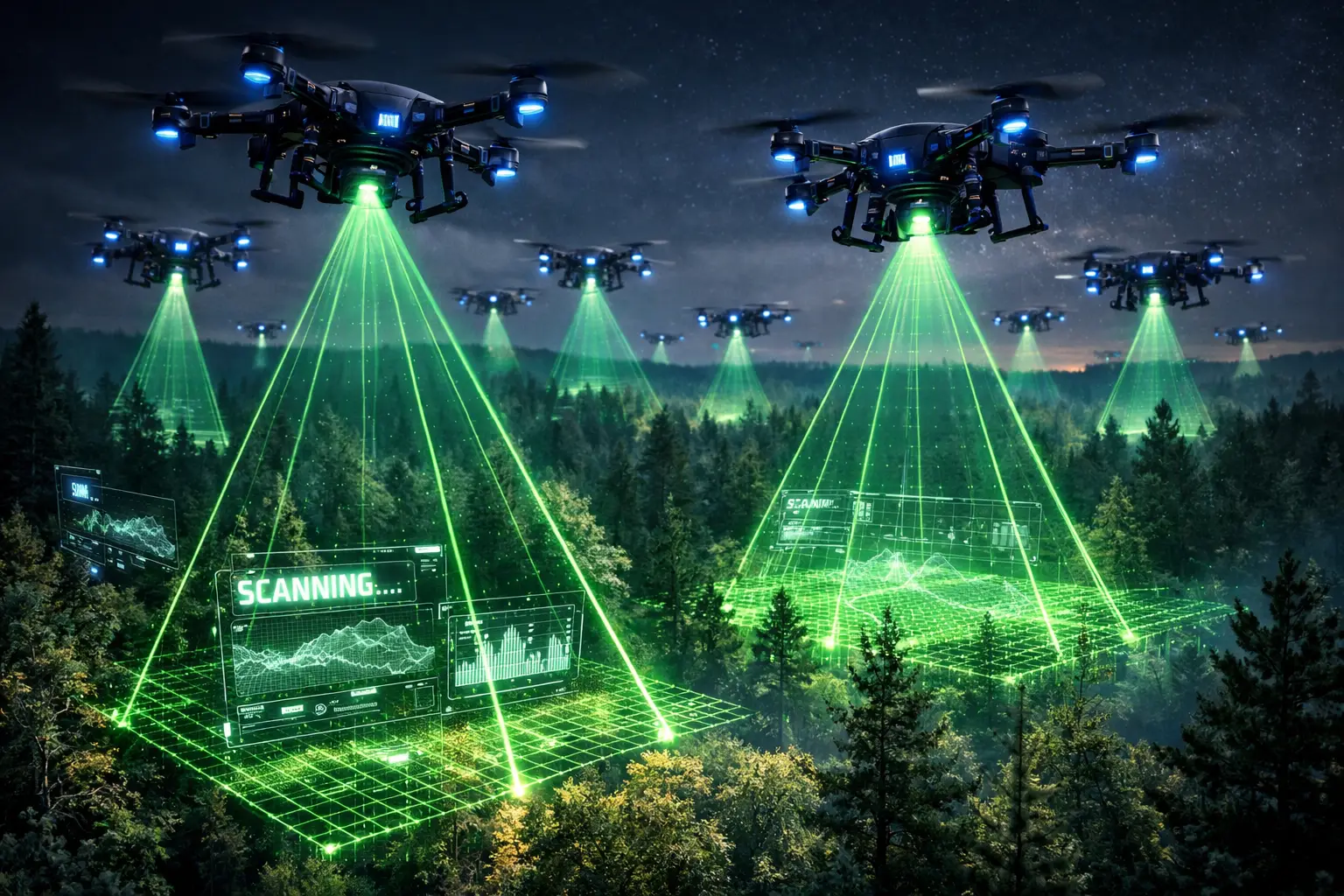
How MD1’s COV architecture turns multi-drone operations from fragile coordination into self-healing cognitive systems
What people underestimate about multi-drone systems isn’t flight. It’s continuity.
Drones don’t fail dramatically most of the time—they drift, batteries dip, links degrade, one unit quietly peels off. And unless someone is watching closely, a hole opens in coverage. That’s where most systems break. Not because a drone crashed, but because no one noticed fast enough.
At MyData1 (MD1), this exact failure mode is what drove the design of COV — Cognitive Orchestration & Vision.
COV is built specifically to eliminate silent failure at scale.
At the core is a self-healing task re-allocator that runs continuously inside the global orchestrator. Think of it less as “error handling” and more as real-time gap management.
Every drone in the fleet emits a lightweight heartbeat and progress signal on a short cycle. That signal isn’t just “are you alive?”—it includes intent, battery trajectory, task completion state, and semantic context.
The moment a drone signals that it’s going offline—either explicitly or because its battery crosses a safe return threshold—the system doesn’t panic. And it doesn’t pause the mission. It treats the event as a missing puzzle piece.
The first step is identifying the gap. The orchestrator already knows which waypoints or sectors that drone was responsible for. More importantly, it knows what that drone was seeing right before disengaging. Because perception is summarized semantically at the edge, the departing drone hands off a compact description of its last observations: what was scanned, what was ruled out, and what still matters.
This matters because it prevents duplication and blind spots. A replacement drone doesn’t restart the task blindly. It resumes with context.
Next comes reassignment. The orchestrator evaluates the remaining fleet against a simple but effective set of constraints: proximity to the unfinished work, remaining battery margin, and current workload. This is not a human judgment call. And not a brittle rule tree. It’s a bounded optimization problem that runs fast and predictably.
If a suitable candidate exists, the handover happens immediately. Tasks are appended. Waypoints are rebalanced. The mission timeline continues without resetting.
From the operator’s perspective, nothing “breaks.” They see a single alert: one drone is returning, another has absorbed the remaining work, coverage is intact.
If no clean replacement exists—say the entire fleet is energy-constrained—the system escalates intentionally. Instead of failing silently, it asks the human a meaningful question: which priority should survive?
That’s the only moment human intervention is required. And it happens at the level of intent, not micromanagement.
What makes this robust is that the logic doesn’t rely on perfect connectivity. Task state is maintained in a distributed way. The orchestrator holds the global plan, but each drone also carries awareness of its neighbors’ roles. If the central link flickers, nearby drones can temporarily negotiate coverage locally until synchronization is restored.
That’s how you prevent cascading failure from a single dropped connection.
This architecture solves three practical problems at once.
First, there’s no data loss. Because perception is summarized continuously through vision-language models, insights are logged as they happen. Even a hard failure doesn’t erase what the system already learned.
Second, scaling stays predictable. Adding more drones doesn’t increase human workload. It increases available battery, sensing, and compute capacity in the orchestration pool. The math scales. The human doesn’t.
Third—and this is the quiet win—the cognitive burden collapses. The operator is no longer playing traffic cop, watching dashboards for subtle anomalies. They’re supervising outcomes. They’re only pulled in when the system genuinely runs out of mathematical options.
This is why, at MD1, we don’t think of COV as “drone autonomy.”
It’s resilience through orchestration.
The difference between a collection of smart drones and a cognitive system is what happens when something goes wrong.
Most systems stop.
COV adapts, reflows, and keeps going.
About Alan Scott Encinas

I design and scale intelligent systems across cognitive AI, autonomous technologies, and defense. Writing on what I've built, what I've learned, and what actually works.

About • Cognitive AI • Autonomous Systems • Building with AI
RELATED ARTICLES
→ The Death of the Pilot: Why COV is the Future of Drones