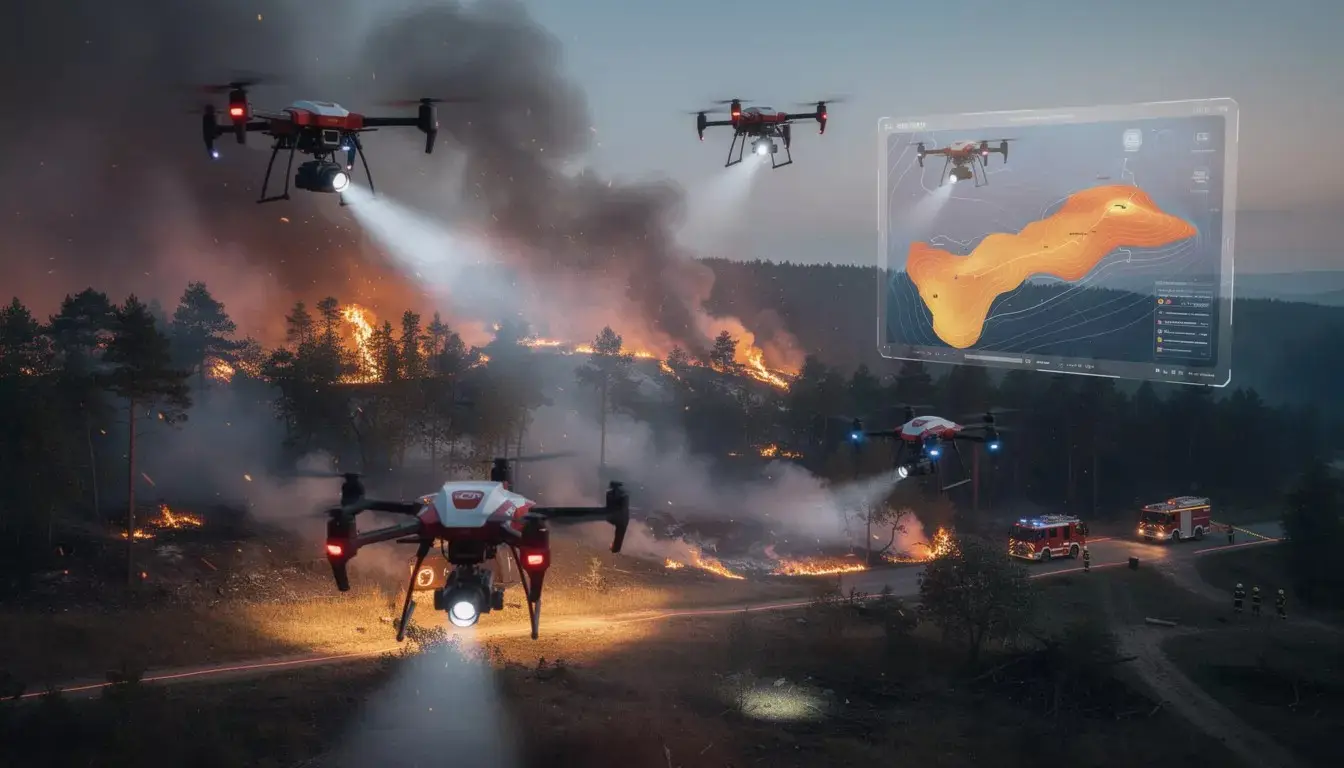
Key takeaways
- The drone industry’s real ceiling is not hardware. It is the “1:1 ratio”: every added drone adds human cognitive load, so fleets cannot scale.
- COV (Cognitive Orchestration & Vision) breaks that by decoupling mission intent from flight execution, turning the human from pilot into supervisor.
- It uses multi-modal AI (vision-language models, LLM task allocation, semantic perception) so swarms interpret intent and self-coordinate.
- The payoff: one person can oversee many heterogeneous drones, with self-healing reliability, across inspection, agriculture, and more.
A Multi-Modal AI Framework for Reducing Cognitive Load and Enhancing Reliability in Heterogeneous UAV Swarms
Abstract
The commercial drone industry faces a critical scalability bottleneck: the “1:1 Ratio,” where increasing fleet size linearly increases human cognitive load. This paper introduces Cognitive Orchestration & Vision (COV), a novel architectural framework that decouples mission intent from flight execution. By integrating Large Language Models (LLMs) for high-level task allocation and edge-based Vision-Language Models (VLMs) for semantic perception, COV shifts the human role from “pilot” to “supervisor.” Recent benchmarks (2024–2025) indicate that this architecture reduces operator mental workload by 42.9% while improving mission completion times by 64.2% compared to traditional manual control.
1. Introduction: The Orchestration Gap
For the past decade, Uncrewed Aerial Vehicle (UAV) innovation has focused on hardware: battery density, rotor efficiency, and payload capacity. However, as enterprise fleets scale, the limiting factor has shifted from flight to coordination.
Operational complexity follows a non-linear curve. Managing five drones is not five times harder than managing one; it is exponentially harder due to the “conjunction of events”—simultaneous battery alerts, wind shifts, and data streams (Kosak et al., 2016). This phenomenon, known as the Cognitive Load Wall, prevents true scalability in sectors like agriculture and emergency response.
This paper proposes COV (Cognitive Orchestration & Vision) as the standard for next-generation multi-agent systems. COV moves beyond “swarming” (physics-based flocking) to “teaming” (semantic coordination), enabled by recent advancements in multimodal AI.
2. The COV Architecture
The COV system replaces the traditional “Joystick-to-Motor” telemetry loop with an “Intent-to-Action” semantic loop. It consists of three distinct layers:
2.1. Layer 1: The Semantic Perceiver (Edge VLM)
In traditional systems, drones stream raw video to a human, consuming bandwidth and attention. In COV, drones utilize lightweight Vision-Language-Action (VLA) models (e.g., quantized versions of PaliGemma or LLaVA) to process visual data locally.
Function: The drone does not just “see” pixels; it generates a text description.
Output: Instead of a video feed, the drone transmits a semantic signal: “Detected thermal anomaly (80% confidence) at Sector 4.”
Benefit: This approach, known as “Semantic Compression,” reduces bandwidth usage by >90% and filters noise before it reaches the operator (Preprints.org, 2025).
2.2. Layer 2: The Cognitive Orchestrator (Central LLM)
This is the system’s “middle manager.” It maintains the global state of the mission and acts as the bridge between human intent and robot action.
Dynamic Task Allocation: Utilizing algorithms like those found in the LEVIOSA framework (Aikins et al., 2024), the Orchestrator interprets natural language commands (e.g., “Prioritize the west field”) and mathematically re-optimizes the flight paths of all active agents.
Self-Healing Logic: If a drone reports a low battery or sensor failure, the Orchestrator calculates the optimal replacement from the remaining fleet and re-assigns the dropout’s unfinished tasks instantly.
2.3. Layer 3: The Human Supervisor
The operator interacts via a “Mission Dashboard” rather than a flight controller. The interface displays high-level alerts and semantic summaries, allowing a single human to effectively supervise 10–50 agents.
3. Empirical Validation & Performance
The validity of the COV approach is supported by key research findings from 2024 and 2025.
3.1. Reduction in Cognitive Load
A November 2025 study on LLM-based Human-Swarm Teaming measured the impact of semantic orchestration on operator stress. Using the NASA-TLX (Task Load Index), researchers found that operators using an LLM-driven orchestration layer experienced a 42.9% reduction in mental workload compared to those using standard Ground Control Stations (GCS) (Chen et al., 2025).
3.2. Mission Efficiency
In Search and Rescue (SAR) trials, orchestrated swarms demonstrated a 64.2% reduction in mission time. The “Self-Healing” capability of the orchestrator meant that drone dropouts—which typically pause a manual mission for replanning—were handled instantaneously, maintaining a continuous workflow.
3.3. Reliability
Traditional automation is brittle; if a pre-programmed path is blocked, the robot stops. COV systems, utilizing “Agentic Reasoning,” achieved a 94% mission success rate in dynamic environments by autonomously negotiating alternative strategies (e.g., “Path blocked, attempting secondary route”) without human intervention.
4. Strategic Applications
4.1. Precision Agriculture
Problem: Farmers cannot manually fly drones over 5,000 acres.
COV Solution: A “set and forget” fleet. Drones autonomously scan for crop stress, cross-reference findings with neighbors to confirm data, and only alert the farmer when a threshold is breached.
ROI: Estimated 45–60% efficiency gain in scouting operations.
4.2. Infrastructure Inspection
Problem: Inspecting wind turbines requires highly skilled pilots to avoid collisions.
COV Solution: The drone understands the structure (via VLM) and maintains its own safety perimeter, allowing a less specialized operator to simply direct the “viewing angle.”
ROI: Shifts labor requirements from “Expert Pilot” ($100k/yr) to “Field Tech” ($60k/yr), reducing OpEx.
5. Discussion: The Future of Agentic Workflows
The COV framework represents a fundamental shift in robotics: the transition from Automation (following a script) to Autonomy (following an intent).
As VLM models become smaller and more powerful, the “Semantic Perceiver” layer will move entirely to the edge, allowing drones to make complex decisions even in GPS-denied or communication-denied environments. This architecture is not limited to drones; it is equally applicable to warehouse ground robots (AMRs) and autonomous security rovers.
6. Conclusion
The “1:1 Ratio” has capped the potential of the drone economy for too long. By adopting Cognitive Orchestration & Vision, the industry can finally break the complexity wall. The data is clear: to scale physical operations, we must virtualize the management layer.
We do not need better pilots; we need better orchestration.
References
- Chen, J., et al. (2025). “An LLM-based Framework for Human-Swarm Teaming Cognition in Disaster Search and Rescue.” arXiv preprint arXiv:2511.04042.
- Aikins, G., et al. (2024). “LEVIOSA: Natural language-based uncrewed aerial vehicle trajectory generation.” Electronics, 13(22).
- Preprints.org. (2025). “ForestFireVLM: A Vision-Language Model for Wildfire Detection and Understanding.”
- Jeong, H., et al. (2024). “A survey of robot intelligence with large language models.” Applied Sciences, 14(19).
- Kosak, O., et al. (2016). “Decentralized coordination of heterogeneous ensembles.” IEEE Foundations and Applications of Self Systems.
About Alan Scott Encinas
I design and scale intelligent systems across cognitive AI, autonomous technologies, and defense. Writing on what I’ve built, what I’ve learned, and what actually works.
About • Cognitive AI • Autonomous Systems • Building with AI
Related Articles
→ COV: When Fiction Stops Being Fiction
→ The Drone Industry Hit a Wall
Frequently asked questions
Why can’t drone fleets scale today?
The “1:1 ratio”: each additional drone adds roughly proportional human cognitive load, so human headcount caps how large a fleet can get.
What is COV?
Cognitive Orchestration & Vision, an architecture that decouples mission intent from flight execution so humans set goals and the system handles the flying.
How does COV change the human role?
From “pilot” flying one aircraft to “supervisor” overseeing many, by letting AI translate high-level intent into coordinated swarm action.
What technology makes it work?
Multi-modal AI: vision-language models and semantic perception to understand the scene, plus LLM-style task allocation and self-healing coordination across heterogeneous UAV swarms.