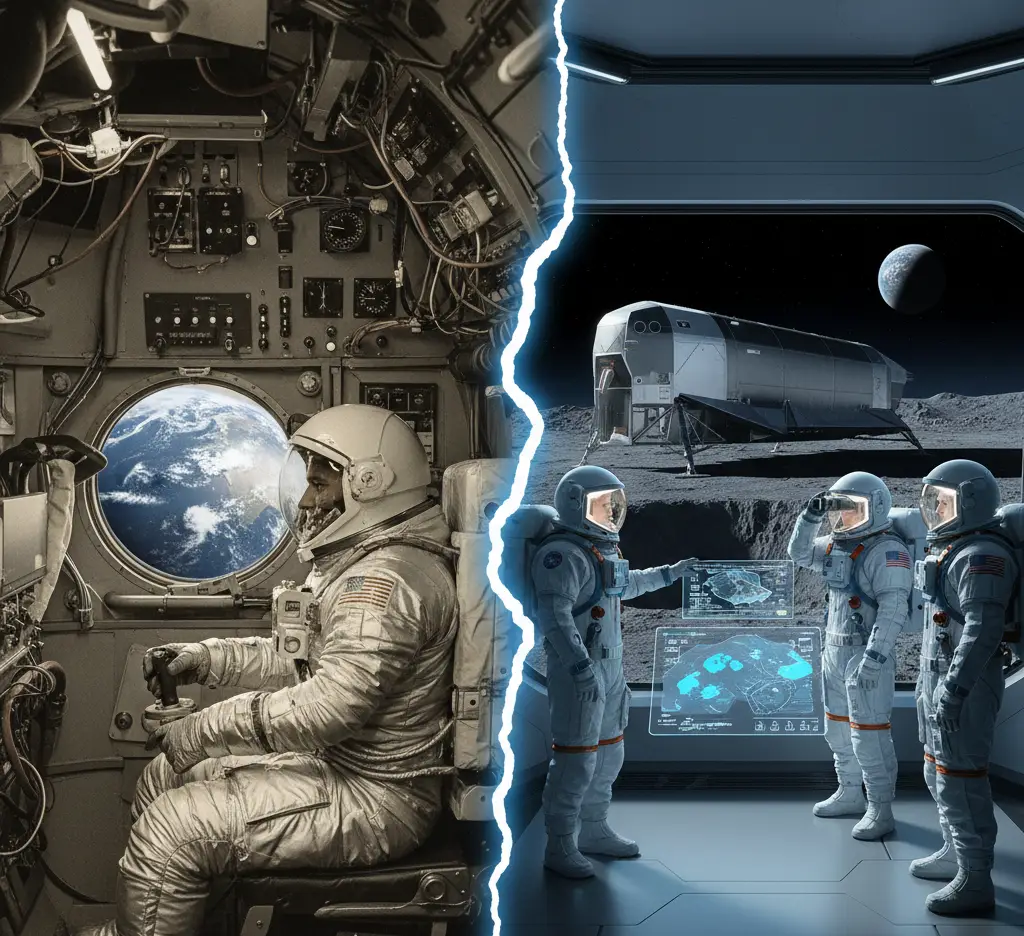
Key takeaways
- The space race was not born from optimism. It was born from fear. In the Cold War, putting something in orbit was a statement of power.
- Project Mercury was “man-in-a-can” survival engineering: keep a human alive inside metal on controlled violence, with no pause button.
- Artemis marks the shift from surviving space to living in it, from fear-driven firsts to the discipline of endurance, infrastructure, and continuity.
- The throughline: engineering matured from “can we survive this once?” to “can we stay?”
There was a moment in human history when the future didn’t feel inevitable. It felt fragile.
Picture the early 1960s. Night launches that turned the Florida coast white with fire. Control rooms heavy with cigarette smoke and quiet panic. Men in short-sleeve shirts staring at oscilloscopes and hand-drawn plots, knowing that once the rocket left the pad, there was no pause button, no rewind, no second try. Just a human sealed inside metal, balanced on controlled violence, pointed away from Earth with more questions than answers.
That feeling came back to me while watching For All Mankind. The show strips away nostalgia and reminds you of something we tend to forget: the space race wasn’t born from optimism. It was born from fear.
After World War II, the world split into two rival power blocs. The United States and the Soviet Union didn’t fight each other directly, but they competed everywhere else — weapons, technology, ideology, influence. This period became known as the Cold War, not because nothing was happening, but because everything was happening indirectly.
Space became the ultimate proving ground.
Putting something into orbit wasn’t just science. It was a statement. It said our technology works, our systems hold, our future reaches beyond this planet. The first satellite. The first animal. The first human. Each milestone wasn’t just progress. It was power.
But beneath the politics was a far more human question. No one knew if the human body could survive space. Would blood circulate? Would vision fail? Would panic override training? Would the mind break before the machine did?
That uncertainty forced the creation of Project Mercury.
Despite the name, Project Mercury had nothing to do with the planet. It was the first American human spaceflight program, designed around one goal so simple it was terrifying: send one person into space and bring them back alive. No long missions. No exploration plans. No permanence. Just survival.
At the time, computers filled entire rooms. Calculations were done by teams of human “computers” using slide rules and mechanical intuition. Navigation meant predicting the future by hand and hoping reality agreed. And once the hatch closed, the only intelligence onboard was the pilot.
The technology reflected that narrow, unforgiving goal. Mercury capsules were brutally constrained — less a cockpit and more a man-in-a-can, with barely enough room to sit, breathe, and exist. Rockets were adapted ballistic missiles, repurposed weapons of war. Guidance computers had kilobytes of memory. Much of the logic was analog, hard-wired, or calculated on the ground and trusted in flight.
Mercury was the science of ballistics and ablation. The heat shield was designed to die. It charred, cracked, and flaked away on reentry, sacrificing itself so the person inside might live. Every design choice was a tradeoff.
Spacesuits weren’t built for work. They were pressurized lifeboats, meant to keep a human alive for minutes at a time.
As John Glenn later said, “There was never any certainty that the mission would work. You just accepted that and went.”
Mercury didn’t eliminate fear. It engineered around it. If the rocket failed, an escape tower pulled the capsule clear. If reentry burned hotter than predicted, the shield was shaped to push energy outward. If communication dropped, ships and antennas were scattered across the oceans so silence never lasted too long.
The Moon, back then, was a destination defined by distance, not understanding. We had limited imagery and crude maps. Trajectories were inferred. Landing sites were chosen for flatness — what we could reach, not what we truly knew.
And still, it worked.
Humans left Earth and came home. That single fact rewired everything that followed.
Today, the Artemis program exists in a completely different frame of mind. The problem is no longer how to get humans there. It’s how to keep them alive long enough to build something that lasts.
Rockets are no longer one-off statements. They’re part of a sustained architecture. We’ve moved from the science of survival to the science of sustainability.
Artemis is aimed at the Moon’s south pole, a place shaped by shadow. Permanently shadowed regions that haven’t seen sunlight in billions of years, with temperatures so low they rival the coldest places in the known solar system.
In that darkness lies distant ice. Not metaphorical ice, but real, ancient ice — water that can be split into oxygen to breathe and hydrogen to fuel what comes next. For the first time, we’re not planning to bring everything with us. We’re learning how to live off the land.
This isn’t a visit. It’s preparation.
Navigation now blends inertial sensing, terrain-relative vision, and autonomous decision-making. Spacesuits are no longer emergency gear. They’re mobile habitats, built for long hours in abrasive, glass-like dust. Life support isn’t measured in minutes anymore, but in cycles — closed loops that must not fail quietly.
The people stepping into these systems reflect that evolution. Mercury astronauts were test pilots, chosen for their ability to stay calm inside experimental machines. Artemis astronauts are scientists, engineers, physicians, and explorers, selected to extract knowledge from uncertainty.
As Christina Koch put it, “We are going to the Moon to learn how to go to Mars.”
That sentence changes everything. It turns the Moon from a destination into a classroom — close enough to reach, harsh enough to expose weak systems, and unforgiving enough to teach what will matter later.
Mars won’t allow improvisation. It won’t offer quick returns. It won’t tolerate bringing everything “just in case.” The Moon is where those realities stop being theoretical and start becoming real.
Mercury taught us we could leave Earth and survive. Apollo taught us we could reach another world. Artemis is teaching us how to stay, how to learn, and how to move forward with intention.
What once lived only in science fiction is being assembled piece by piece, not as fantasy but as infrastructure. Discovery has never happened because fear disappeared. It happens when fear is acknowledged, engineered around, and carried forward anyway.
What Mercury proved was that survival beyond Earth was possible, but Artemis is forcing a deeper reckoning with what survival actually means. The Moon is becoming the first place where humanity learns how to persist without immediacy, how to operate when help is distant and silence is normal, and how to build systems that don’t rely on urgency or heroics to hold together. In the cold and shadow of the lunar south pole, exploration slows down and matures, shifting from moments of daring to patterns of endurance. Somewhere between the fire that once lifted us away from Earth and the ice that has waited untouched for billions of years, we are learning how to carry human presence forward deliberately, without rushing back to what feels familiar, and without mistaking survival for the end of the story.
About Alan Scott Encinas
I design and scale intelligent systems across cognitive AI, autonomous technologies, and defense. Writing on what I’ve built, what I’ve learned, and what actually works.
About • Cognitive AI • Autonomous Systems • Building with AI
Related Work
→ When Sci-Fi Stops Being Fiction
→ Cognitive AI: The Next Leap from Algorithms to Awareness
Frequently asked questions
Why did the space race begin?
Not from optimism but from Cold War fear. Orbit was a statement of technological and ideological power between the United States and the Soviet Union.
What was Project Mercury?
The early “man-in-a-can” survival missions: sealing a human inside metal atop a rocket to prove a person could survive spaceflight at all.
How is Artemis different from Mercury?
Mercury was about surviving space once; Artemis is about living and building there. It is the shift from fear-driven firsts to endurance and lunar infrastructure.
What is the bigger lesson?
Space engineering evolved from desperate survival to the discipline of continuity: not just reaching a place, but staying.
→ How We Accidentally Built the Death Star and Called It the Golden Dome