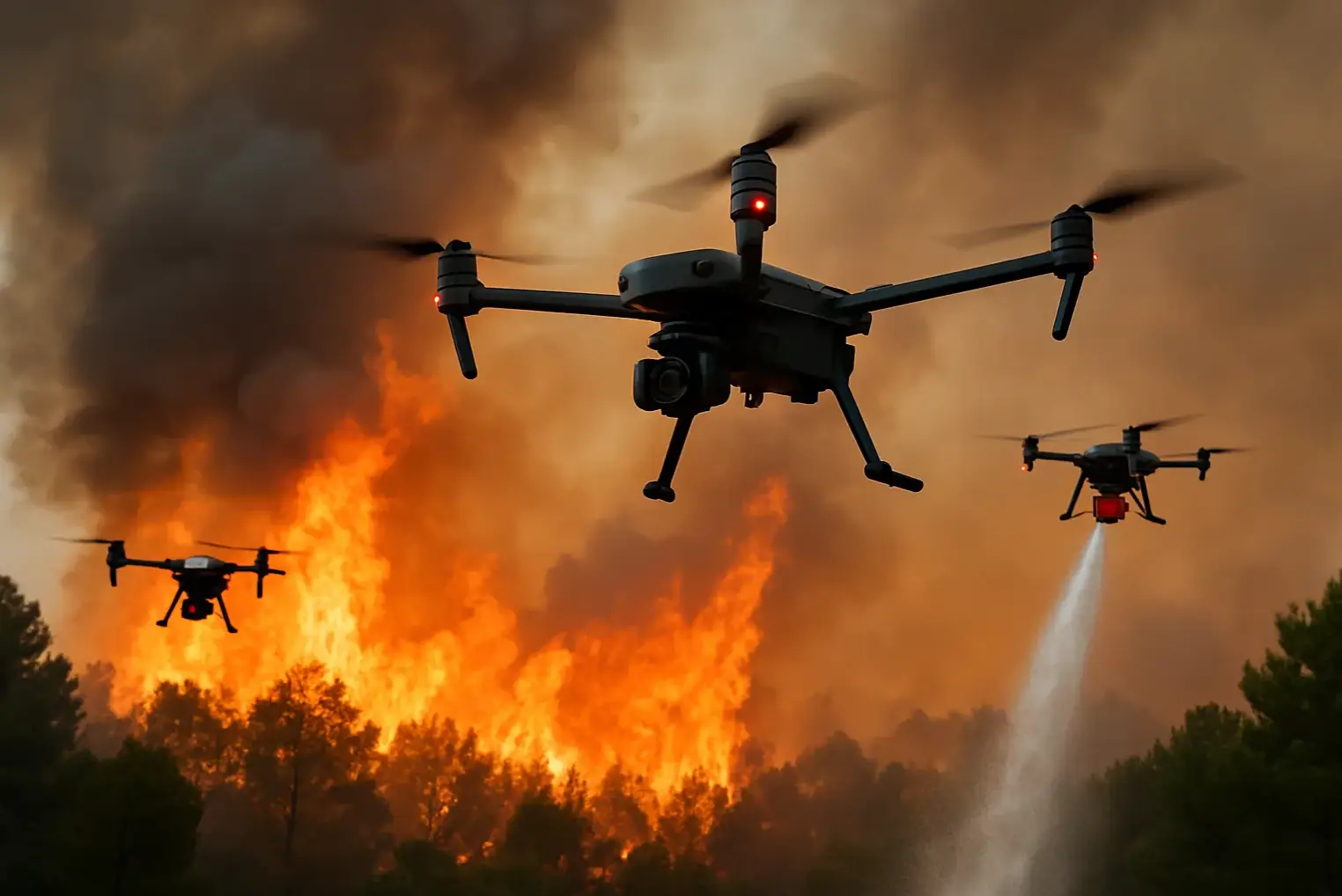
Why adding more drones is making operations slower, not smarter
For the last decade the drone industry has chased better hardware, longer flight times, sharper cameras, and faster processors.
That race is largely over.
In 2025, the limiting factor in drone operations is no longer what drones can do. It’s what humans can manage.
As fleets scale beyond one or two units, organizations hit a hard ceiling: the Cognitive Load Wall. Each additional drone doesn’t add linear capability—it adds exponential complexity. More video feeds, more battery states, more edge cases, and more decisions per minute than a human operator can reliably process.
The result is a familiar paradox: more drones, less efficiency.
This isn’t a hardware problem. It’s a coordination problem.
The Hidden Tax of Scale
Adding drones to a mission looks efficient on paper. In reality, it introduces three compounding costs.
First, information overload. A single operator cannot meaningfully monitor multiple high-resolution video streams at once. Attention fragments and signals turn into noise.
Second, mission drift. Real-world conditions change constantly—wind shifts, batteries deplete, sensors degrade. Manual task reassignment is slow and error-prone, especially under pressure.
Third, training friction. Certified drone pilots are expensive and slow to onboard. Scaling operations means scaling specialized labor, which breaks margins before it improves outcomes.
Together, these factors create a productivity plateau. Organizations spend more to get less.
A Different Model: From Operators to Supervisors
The way forward isn’t asking humans to work harder. It’s changing their role. Instead of micromanaging machines, humans should supervise intent.
This shift is enabled by a Cognitive Orchestration Layer powered by Vision-Language Models (VLMs). The idea is simple but profound: humans issue goals, not commands. Systems handle the coordination.
Rather than manually piloting drones, a supervisor says, “Inspect the north solar array,” and the system decomposes that objective into executable tasks.
The human moves up the abstraction stack. The machines handle the chaos.
How Semantic Orchestration Works
At the core is a three-layer architecture designed to reduce cognitive load rather than add to it.
A global orchestrator acts as the system’s brain. It takes high-level objectives and breaks them into coordinated tasks across the fleet.
Each drone runs a local perception layer using a VLM. Instead of streaming raw video, the drone interprets what it sees and reports concise semantic signals: corrosion detected, crop stress identified, heat anomaly found.
Finally, self-healing logic monitors the fleet in real time. If a drone drops out due to battery limits or failure, tasks are automatically redistributed without human intervention.
The operator stays focused on outcomes, not exceptions.
What This Unlocks in the Real World
When coordination stops being the bottleneck, entire industries change shape.
In precision agriculture, semantic orchestration enables targeted spraying and early stress detection—increasing yields while reducing chemical waste.
In infrastructure inspection, bridges and powerlines can be surveyed faster and more safely—cutting costs compared to manual methods.
In emergency response, search and rescue missions complete significantly faster in high-stress environments where human attention is already stretched thin.
Across multiple deployments in 2025, orchestrated fleets completed missions roughly 60 percent faster while reducing reported mental workload by over 40 percent.
That’s not incremental improvement. That’s a category shift.
The Financial Case Isn’t Subtle
The ROI follows directly from the cognitive shift.
Traditional drone programs invest thousands per pilot in training and certification. Semantic command interfaces reduce onboarding to days, not months. Organizations move from hiring elite specialists to training field technicians who supervise intelligent systems.
Operational reliability improves as well. Self-healing task allocation keeps missions running even when part of the fleet goes offline—protecting expensive hardware investments and improving success rates.
This aligns with a broader trend identified by firms like Deloitte: orchestration, not raw automation, is becoming the real competitive advantage in agentic systems.
From Theory to Deployment
This isn’t science fiction and it doesn’t require a multi-year rollout.
A practical proof-of-concept can be executed in roughly twelve weeks. The process starts with tuning perception models to domain-specific language, followed by a small orchestrated fleet pilot, and ends with full integration into existing asset management workflows.
The technology is ready. The bottleneck is mindset.
The Bigger Shift
What’s happening in drone fleets mirrors a larger pattern in AI systems.
We are moving from tools that extend human hands to systems that extend human judgment.
The future of autonomy isn’t about removing humans from the loop. It’s about lifting them above the noise—where strategy lives and decisions matter.
Hardware got us this far. Orchestration takes us the rest of the way.
The organizations that understand this will scale cleanly. The rest will keep adding drones—and wondering why nothing gets easier.
About Alan Scott Encinas

I design and scale intelligent systems across cognitive AI, autonomous technologies, and defense. Writing on what I've built, what I've learned, and what actually works.

About • Cognitive AI • Autonomous Systems • Building with AI
RELATED ARTICLES
→ The Death of the Pilot: Why COV is the Future of Drones