
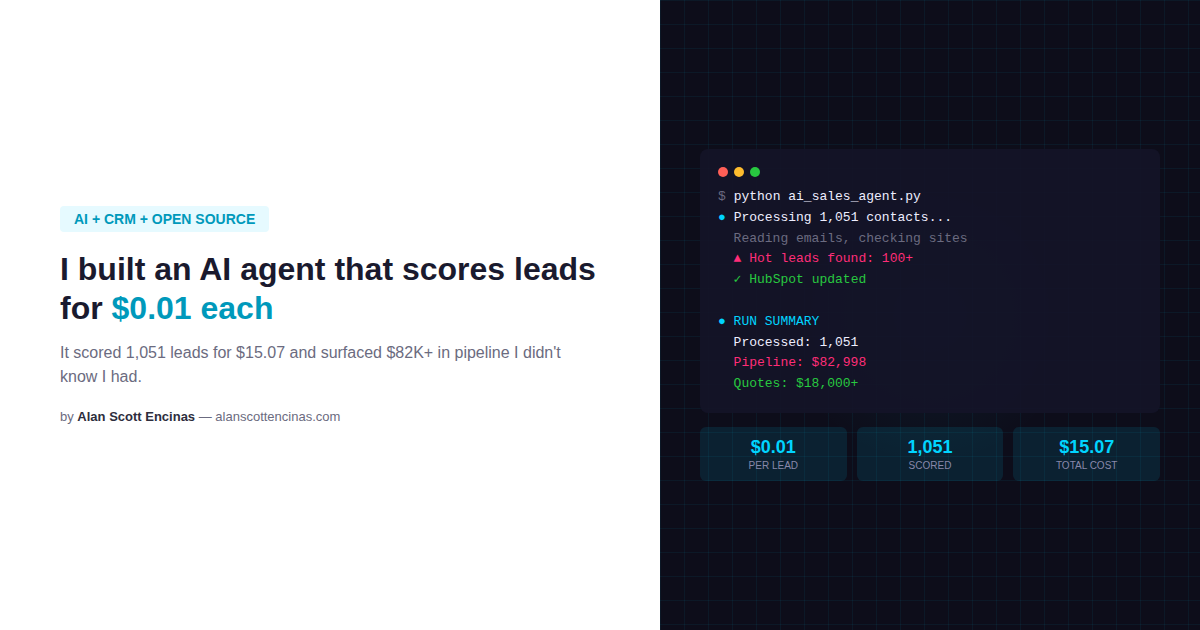
I built an AI agent that reads my CRM emails and scores leads for $0.01 each
It scored 1,051 leads in one run for $15.07 — and surfaced $82K+ in pipeline I didn’t know I had.
The problem
I run a company in the outdoor gear and hospitality industry. We manufacture luxury glamping structures, geodesic domes, and event tents for resort developers, hospitality operators, and event organizers worldwide. A single deal can be worth tens of thousands of dollars. Some clients buy 50-200 structures at a time.
I also do everything alone. Sales, lead gathering, qualification, follow-up, customer service — all of it. My HubSpot CRM had 1051 contacts. Some were resort developers in Costa Rica looking to buy 20 units. Some were people on Instagram asking “how much for a tent?”
They all looked the same in my CRM.
I was spending hours every week scrolling through contacts, trying to remember who was worth calling. Meanwhile, good leads went cold because I couldn’t get to them fast enough. The people who called my cell phone got attention. Everyone else got whatever time was left.
What I built
I built a Python script that connects to HubSpot and uses Claude (Anthropic’s AI) to score every contact in my pipeline. But here’s what makes it different from every other “AI lead scoring” tool: it actually reads the email conversations.
Not metadata. Not “opened email 3 times.” The actual words. The full thread. It reads that a lead wrote “we have 30 acres in Tulum and we’re looking to build a 20-unit eco-resort, what’s your lead time on safari tents?” and it understands that this is a completely different animal than someone who wrote “prices?”
For each contact, the agent:
- Pulls the full email conversation history from HubSpot
- Checks if they have a company linked — if not, extracts the domain from their email and creates one
- Visits their website to verify it’s a real business
- Sends everything to Claude for intelligent scoring
- Writes the score, lane, and reasoning back to HubSpot
The results
On a single production run, the agent scored all 1,051 contacts in my CRM and surfaced over 100 actionable leads — hot and warm prospects I didn’t know were sitting in my pipeline. But the agent didn’t just score them. It told me exactly who to call first, in what order, and what to say when they picked up.
So I called them.
Within days, I’d generated $18,000+ in quotes directly from following the agent’s follow-up recommendations. Total pipeline value identified: $82,998. All from leads that were already in my CRM, already had email conversations with me, and were completely invisible because I didn’t have time to read through hundreds of threads.
One was a resort developer in Baja Mexico with a 12-unit glamping project and construction platforms already built. The original form data was thin — just a name and email from a Facebook ad. But the email conversation revealed everything: specific unit counts, a location, a timeline, and active planning. The agent changed it from Retail/Cold to B2B Development/Hot and told me to call immediately.
Another contact had been tagged as Retail/Warm for weeks. The agent read the email thread and discovered they were an established campground owner with two properties, asking detailed questions about specific models, and had already committed to a call by Thursday. Upgraded to Hot with a specific recommended action: “Prepare pricing on cost-effective models for both campground locations.”
It also found leads I should stop wasting time on. One contact that looked promising had actually been trying to sell promotional services TO my company — not buy from me. The agent caught that from the email content and tagged it as Cold with the note: “No buying intent — attempting to sell services to Trend Tents.”
What it costs vs. everything else
*AI Sales Agent cost based on real production run: 1,051 leads scored for $15.07. Apollo.io and Clay at starter tier pricing.
The total monthly cost for this system is about $35 — that’s $20 for HubSpot Starter and roughly $15 in Claude API costs for a full CRM sweep. For context, HubSpot’s built-in lead scoring requires the Professional plan at $890/month. And their scorer doesn’t read your emails. Mine cost $15 and generated $18K in quotes on the first run.
The ROI is absurd
Based on real production run: 1,051 contacts scored. 100+ actionable leads surfaced. $18K+ in quotes generated within days of following the agent’s call recommendations. $82,998 total pipeline identified.
$15.07 in API costs. $18,000+ in quotes generated. $82,998 in total pipeline surfaced. I called the leads the agent told me to call, and they converted. Those leads were already in my CRM, already had email conversations, and were completely invisible to me because I didn’t have time to read through a thousand threads.
Before and after
Before: manual process
After: AI sales agent
How it works
The architecture is simple. No ML models to train. No databases to maintain. One Python file, two API keys.
HubSpot CRM
  → Pull contacts with recent activity (skip already reviewed)
  → For each contact:
      → Read email conversation history (last 10 emails)
      → Check company association (create from email domain if missing)
      → Visit website (verify legitimacy)
      → Send everything to Claude API
      → Claude returns: lane, score, reason, recommended action
      → Write results back to HubSpot
      → Stamp review date
  → Print summary: hot leads, score changes, companies added
The “intelligence” is a system prompt that describes my business, my customer types, and what signals indicate a hot vs. cold lead. It’s written in plain English — no code, no model training, no feature engineering. You literally describe your business to Claude the way you’d describe it to a new sales hire, and it scores leads based on that understanding.
The scoring logic classifies every lead into a commercial lane (I have five: Wholesale, B2B Development, Event, OEM, and Retail) and then scores them as Hot, Warm, or Cold based on lane-specific criteria. A Hot wholesale lead looks different from a Hot event lead, and the agent knows that.
The email reading is what makes it work
Every other lead scoring tool I looked at scores based on form data and activity metadata — “opened 3 emails, visited pricing page, job title is VP.” That’s useful, but it misses the most important signal: what the person actually said.
When Claude reads an email thread where someone writes “We’re converting 30 acres in Guanacaste into an eco-lodge. Our architect has the platform layouts done. We need 15 safari tents delivered by Q1 2027 — what’s your lead time and bulk pricing?”, it doesn’t need a scoring algorithm. It knows that’s a hot lead because it can read.
Similarly, when it reads a thread where someone asked for a price list, received one, and then went completely silent for 6 months despite 5 follow-ups — it knows that’s cold. And it writes that specific reasoning into HubSpot so when I see the contact, I know exactly why and what to do.
It also cleans up your CRM
One unexpected benefit: company enrichment. About 40% of my contacts had no company linked in HubSpot. The agent checks each contact’s email domain — if it’s a business email (not Gmail/Yahoo), it searches HubSpot for a matching company. If one exists, it links them. If not, it creates the company and links it.
Over two runs, it added 8 companies to my CRM that I never would have created manually. That’s not just tidiness — it’s data quality that makes every future report, filter, and search more useful.
Get the code
The agent is open source. One Python file. One dependency (pip install requests). Customize the scoring logic by editing plain English — no ML knowledge needed.
Free and open source. Works on Mac, Windows, and Linux.
One dependency. Customize scoring in plain English.
Works with HubSpot Free, Starter, Professional, or Enterprise.
Setup takes about 5 minutes: clone the repo, paste two API keys (Claude + HubSpot), create four custom properties in HubSpot, describe your business in the scoring config, and run it.
If you’re a solo operator or small sales team drowning in leads you don’t have time to evaluate, this might be the highest-ROI hour you spend this month.







what are vidalista tablets
what are vidalista tablets
loperamide in neonates
loperamide in neonates