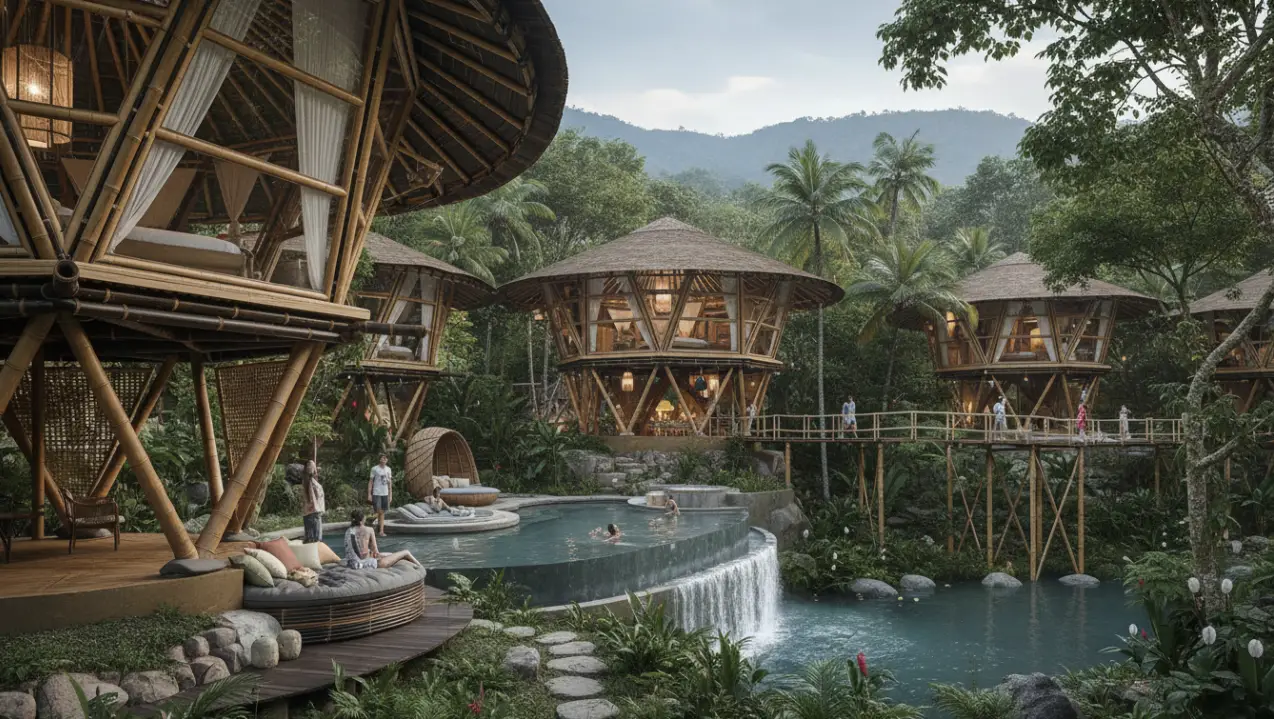
How eco-resorts and community-led hospitality are reshaping the industry
For most of the last century, hospitality scaled by height. Towers, elevators, concrete, and controlled environments. The logic was simple: concentrate guests, standardize the experience, reduce variability.
But the market is changing, and not quietly.
What’s growing now is a different model of development—one that treats land, culture, and community as the core product. Eco-resorts, glamping, and land-integrated projects are expanding because travelers are no longer chasing generic luxury. They’re chasing meaning—a place, a story, and the feeling of being somewhere real.
This shift is doing something bigger than changing design language. It’s building ecosystems.
A town that used to be “too far” becomes valuable again when the experience is rooted in what only that place can offer: food traditions, craft, music, local guides, ancestral history, and the landscape itself. When done well, hospitality stops being a single property and becomes a network of livelihoods.
Mexico is one of the clearest signals.
The country’s Pueblos Mágicos program was created to spotlight smaller towns with unique cultural and historical identity, and many of these places have seen increased tourism attention and investment tied directly to preservation and local character. More recently, UNESCO and Mexico’s Ministry of Tourism have pushed community-based tourism more explicitly, highlighting and promoting over 100 community tourism organizations and cooperatives.
The model isn’t “build a resort and import everything.” It’s “connect towns and let each one carry what it already owns.” Food here. Art there. Music, tours, craft, and local knowledge distributed across communities. That’s how a rural region becomes a destination without losing itself.
Peru shows the same evolution through culture-first experiences.
Community-based tourism has been studied and supported in Peru for years, including programs where local communities host visitors, provide meals, guide experiences, and build resilience through nature-based tourism. One of the most well-known examples is Lake Titicaca’s community-hosted experiences (including Amantaní Island homestays), where the “accommodation” is inseparable from the people, the rhythm of life, and the setting.
This is what’s changing: the destination isn’t a building. The destination is the relationship between place and people.
Chile offers a modern variant: food and production as the center of tourism.
Chile’s “Ruta de los Abastos” initiative has been turning rural regions into tourism circuits built around local producers, traditional practices, and guided experiences that connect visitors to the land through what it grows and what it makes. This is not a sightseeing economy. It’s a participation economy—and it keeps value closer to the source.
Bolivia has long provided examples where community-led eco-tourism is tied directly to conservation and cultural continuity.
Chalalán Eco-lodge in/near Madidi National Park is frequently cited as a model of community-based ecotourism designed to protect biodiversity while creating local income. Other community tourism efforts in Bolivia show the same pattern: helping communities develop tourism offerings that generate income without abandoning culture or land.
Argentina is seeing its own momentum, including formal recognition.
UN Tourism’s “Best Tourism Villages” program has increasingly highlighted rural communities shaping sustainable travel. Recent reporting notes Argentine villages being recognized in this framework, signaling growing global interest in rural destinations built around heritage and environment, not skyscrapers. Argentina’s tourism sector also frames “community-based rural tourism” explicitly as a cooperative, community-led model rather than a top-down resort import.
Put all of this together and a pattern emerges.
The hospitality industry is moving from “property-first” to “place-first.”
It’s a shift from containment to connection:
- from isolating guests to embedding them
- from importing identity to amplifying it
- from one-off resorts to local networks
- from short-term occupancy to long-term regional value
That’s what people mean, even if they don’t say it cleanly, when they talk about eco-resorts “embracing culture.” The industry is finally remembering that land and community aren’t background scenery. They’re the source of the experience.
This is also why the definition of “development” is changing.
The future of hospitality won’t be measured by how high we build. It’ll be measured by how well a project belongs where it stands, how responsibly it uses land, and how much opportunity it creates for the people around it.
At Trend Tents, this is the lens: structures are not the destination. They’re the platform that lets place, culture, and community become the destination.
The towers will always exist. But the growth is moving elsewhere now—into landscapes and towns that were once ignored, and are now becoming the new centers of gravity.
Article Covers:
- Chile’s “Ruta de los Abastos” production-based tourism circuits
- Bolivia’s Chalalán Eco-lodge conservation model
- Argentina’s UN Tourism “Best Tourism Villages” recognition
- Why “development” now means belonging, not building height
- Trend Tents’ place-first infrastructure philosophy
About Alan Scott Encinas

I design and scale intelligent systems across cognitive AI, autonomous technologies, and defense. Writing on what I've built, what I've learned, and what actually works.

About • Cognitive AI • Autonomous Systems • Building with AI
RELATED ARTICLES
→ I Built an App in Four Days and Sold It in One
→ How Early Digital Systems Quietly Shaped the Minds Building Tomorrow