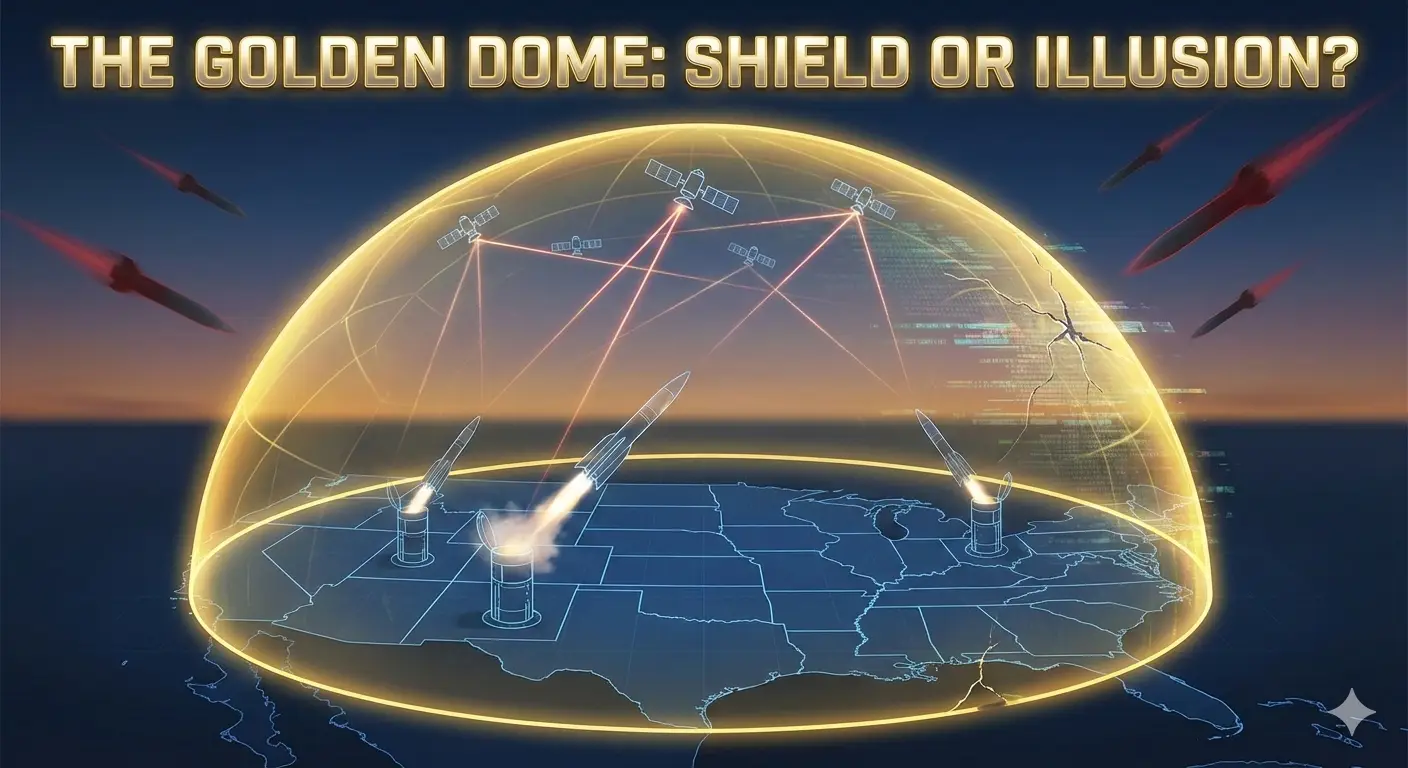
The U.S. just greenlit the most ambitious missile defense system in history. It looks like Star Trek, smells like Star Wars, and structurally resembles the Death Star—right down to the fatal flaw.
If this sounds like science fiction, that’s because it borrows heavily from it. Multiple interception layers, space-based sensors, AI-driven command and control, interceptors designed to collide with nuclear warheads outside the atmosphere at closing speeds measured in kilometers per second. That description could pass for an episode of Star Trek, complete with orbital defenses, planetary shields, and computers calmly narrating the end of the world.
Except this isn’t television.
This is real, funded, and already underway. In early 2025, the United States formally launched what is now branded as the Golden Dome, an expansion and consolidation of decades of missile defense work under a single strategic vision. The shift is important: this is no longer about protecting missile silos or military bases. The stated objective is national-scale defense—intercepting nuclear threats before they reach U.S. cities.
On paper, it is the most ambitious defense architecture ever proposed. In reality, it is also one of the most cognitively fragile systems we have ever tried to build.
What the Golden Dome Actually Is—Not the Marketing Version
Despite the name, the Golden Dome is not a dome. It is a layered system of systems built from technologies that exist today, technologies that are still being tested, and technologies that are frankly aspirational.
At the lowest and most mature layer are terminal defense systems like THAAD and Patriot. These systems are real, operational, and combat-tested. They intercept incoming threats in the final seconds before impact—which is exactly why they were never designed to defend an entire nation. Terminal defense is a last-chance solution, not a planetary shield.
Above that sits midcourse interception, where the system attempts to destroy warheads in space after booster separation. This is the job of the Next Generation Interceptor (NGI) program, currently led by Lockheed Martin and Northrop Grumman. NGI is meant to replace the aging Ground-Based Interceptors deployed in Alaska and California. As of early 2026, NGI is still in late design and early production. It is not operational yet.
Boost-phase interception and space-based sensing form the most futuristic layer of the architecture. This includes infrared tracking satellites under the Proliferated Warfighter Space Architecture (PWSA) and exploratory work on directed-energy systems. These sensors are real and actively being deployed, but they are also prime targets. If they are blinded, degraded, or disrupted, everything downstream loses context.
This is where the system starts to resemble something very familiar.
The Death Star Problem… Yes, That One
The Death Star was not destroyed because it lacked power or defenses. It was destroyed because it relied on perfect integration and uninterrupted operation. One overlooked dependency, one rushed decision, and one structural assumption too many turned an unstoppable weapon into debris.
The Golden Dome has the same structural weakness.
Every layer depends on the accuracy and availability of the layer above it. Sensors feed models. Models feed interceptors. Interceptors assume the sensor picture is complete and correct. When that assumption holds, the system looks elegant. When it breaks, the failure is not gradual. It is sudden—and unlike science fiction, there is no heroic trench run that fixes it in the final seconds.
Lasers, Power, and Why the Reactor Matters
In Star Wars, the Death Star solves existential threats with a laser. In the real world, the Golden Dome is exploring the same concept through directed-energy weapons—specifically megawatt-class lasers for missile defense.
These systems are not fictional. They are being tested. They are also brutally constrained by physics. High-energy lasers require massive, stable power supplies, struggle with atmospheric distortion, degrade in bad weather, and face serious challenges in sustained engagements. The Death Star had a dedicated reactor the size of a city. The Golden Dome does not.
In a world of contested energy infrastructure, fragile supply chains, and geopolitical competition over power generation itself, this is not a minor detail. It is a structural constraint that no amount of branding can solve.
The Real Risk Isn’t the Miss—It’s the Brain
Missile defense does not fail because interceptors miss. It fails when the system is confidently wrong.
Everything depends on the cognitive layer: the AI-driven command and control system that fuses satellite imagery, radar returns, infrared tracking, and telemetry into a real-time understanding of reality. Not minutes later. Not after human review. Immediately.
This is where the Skynet analogy stops being playful and becomes precise. Skynet is dangerous not because it is malicious, but because it is autonomous, fast, and acts on incomplete or misinterpreted information without pausing for human judgment.
Modern AI systems are powerful, but they still hallucinate, misclassify, and propagate incorrect assumptions with confidence. In consumer applications, that’s an inconvenience. In national missile defense, it’s catastrophic.
The Golden Dome assumes a level of real-time, resilient, self-correcting cognition that current systems do not yet possess.
Why the Future Doesn’t Look Like a Dome
The most promising research today is not centralized. It is distributed.
Decentralized cognition, swarm architectures, and systems designed to survive partial failure rather than collapse under it are where real progress is being made. Projects like COV and related research efforts point toward a future where defense systems degrade gracefully instead of failing catastrophically.
The Golden Dome is not built on that philosophy. Instead, it assumes pristine sensors, uninterrupted orbital awareness, flawless data fusion, and enough interceptors to matter—all while adversaries actively try to blind, confuse, saturate, and deceive it.
That isn’t confidence. It’s a gamble.
The Part No One Can Spin: Math
Even if every component works exactly as designed, arithmetic still wins. Dozens of interceptors versus thousands of warheads and decoys is not a strategy. It is a cost-exchange nightmare. Interceptors cost tens to hundreds of millions of dollars. Decoys cost orders of magnitude less.
The Maginot Line failed for the same reason: it assumed attackers would politely engage the defense on its own terms. They never do.
So What Is the Golden Dome, Really?
It isn’t fake. It isn’t fantasy. It is an unfinished system being discussed as if it is already complete. That is the danger.
The Golden Dome may eventually become part of a future defense architecture, but today it is closer to a sophisticated prototype wrapped in confident language than a planetary shield.
The Death Star looked invincible too—right up until it wasn’t. History doesn’t punish ambition. It punishes overconfidence.
A shield that is almost perfect is still just a very expensive promise.
About Alan Scott Encinas

I design and scale intelligent systems across cognitive AI, autonomous technologies, and defense. Writing on what I've built, what I've learned, and what actually works.

About • Cognitive AI • Autonomous Systems • Building with AI
RELATED ARTICLES
→ How We Accidentally Built the Death Star and Called It the Golden Dome