
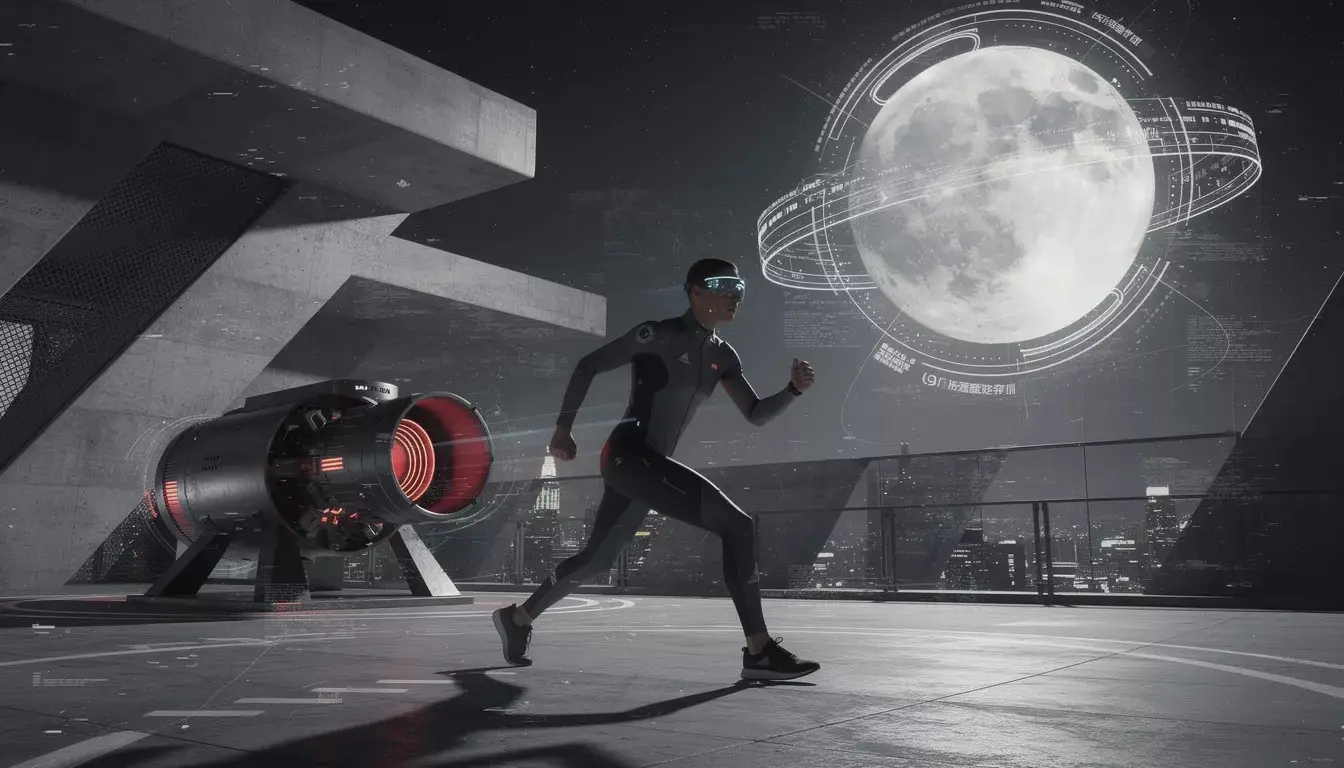
AI did not wait for permission to change aviation or space. It simply stepped in and started doing the work. In only a few months, we moved from talking about autonomous systems as distant possibilities to watching them fly fighter jets, navigate the darkest parts of the Moon, and run on hardware powerful enough to reshape the pace of innovation.
At the same time, technologies that once lived in Star Trek episodes or Terminator plotlines have quietly entered the real world. Nuclear propulsion is being tested. Machine intelligence is becoming operational. And robots are preparing terrain long before human boots return.
For anyone who grew up with films like Stealth, Alien, WALL-E, or the entire Terminator universe, what is happening right now feels strangely familiar. Not because we are living inside those stories, but because the ideas they introduced are finally crossing into real engineering.
These changes are not isolated. They are happening together, feeding into each other and accelerating the speed of progress. Three breakthroughs from the past six months show how far we have already traveled.
1. The First Real AI Fighter Pilot
The most striking development did not originate in a government hangar. It came from Shield AI.
In late 2025, the company revealed X-BAT, a fully autonomous jet powered by the Hivemind AI. This was the same intelligence that flew an F-16-class X-62A VISTA in real dogfights against a human pilot. These were not controlled demos inside a simulator. They were actual air engagements with real G-forces and unscripted decisions.
Hivemind learns through millions of simulated battles. It does not follow a preset list of maneuvers and it does not rely on rules that limit what it can attempt. It evolves strategy the way Skynet might have—if it learned through pure reinforcement. Since the system feels no fear and no physical strain, it explores maneuvers only through the logic of geometry and probability. It leans into risks humans cannot take because our bodies simply break before we can complete the move.
X-BAT brings that intelligence into a platform shaped for autonomy. It launches vertically. It functions without GPS. It does not depend on perfect communication links. And it does not need a human inside the cockpit.
This is the first aircraft designed entirely around the capabilities of the machine. It behaves like the experimental jet in Stealth or the hunter drones imagined in the early Terminator films—but without the cinematic framing. It is here. It works. And the world has barely reacted.
2. Artemis Is Quietly Becoming an AI Program
Most people talk about Artemis as NASA’s effort to return humans to the Moon. The deeper truth is that Artemis now depends on AI in the same way the Nostromo in Alien depended on Mother—the ship’s calm, ever-present intelligence.
The lunar south pole is too dark, too unstable, and too unforgiving to navigate without machine vision. If humans step into Shackleton Crater without support, they will be effectively blind.
The Lunar Autonomy Challenge showed the direction this is heading. One of the strongest entries came from Stanford’s NAV Lab. Their system used a Segment-Anything transformer backbone with specialized heads for depth and segmentation. They trained it on the LuSNAR synthetic dataset, built to mimic the crater rims, harsh shadows, and unpredictable terrain that can flip a rover in seconds. After training, they distilled the model down to run on the low-power processors that real rovers carry.
This work is important because these systems will be the first explorers. They see in lighting conditions that confuse human eyes. They navigate without GPS. They build maps with the same steady focus as the robots in WALL-E, but in an environment far more extreme.
Artemis is not just about planting a flag. It is about building machine intelligence capable of scouting the paths humans cannot travel alone.
3. The Hardware and Propulsion Shift That Changes Everything
Every major step in AI begins with a step in hardware. NVIDIA’s Blackwell B200 arrived with almost unbelievable numbers. About 20 petaFLOPS of AI compute per chip. Stacked HBM4 memory from SK hynix that feeds it with massive bandwidth. This is the infrastructure training AI fighter pilots, lunar perception systems, and the next generation of autonomous machines. It is the kind of hardware that makes early Star Trek computing look quaint.
Then there is propulsion. Russia recently tested two nuclear-powered systems that prove nuclear engines are no longer science fiction. Poseidon, a nuclear-powered underwater drone, completed a reactor test that gives it almost unlimited underwater range. Burevestnik, a nuclear-powered cruise missile, flew more than 14,000 kilometers in about fifteen hours.
These systems are not peaceful exploration craft—yet they confirm that nuclear propulsion is now operational. The idea that once lived only in deep-space concepts and sci-fi storytelling is now something you can measure, track, and analyze in real time.
This is the part of the story that people understood instinctively when watching Star Trek’s warp core or the eerie reactor rooms in Alien. Endless power changes the shape of what machines can do. We are watching that shift begin.
The New Frontier Is Already Here
These developments are not disconnected. They form a pattern.
AI can fly aircraft that push the limits of physics. It can navigate the Moon with clarity and focus. It is trained on hardware that learns at speeds that were impossible until recently. And nuclear propulsion systems are proving themselves in the real world, showing how far machines can travel without support.
It is impossible not to think of the stories that predicted these moments. Terminator warned us about runaway autonomy. Alien showed us the quiet confidence of ship-level intelligence. WALL-E gave us a glimpse of robots filling the gaps where humans cannot or do not. Star Trek imagined propulsion and compute breakthroughs long before they were practical.
The difference now is that these ideas are no longer “visions of the future.” They are reference points for a world that is rapidly forming around us.
We are entering a decade where intelligent systems will not stay inside our devices. They will fly our machines, map our worlds, guide our exploration, and shape the edges of the next frontier.
This is not the climax of AI. It is the opening chapter.
The last six months proved that the next leap will not feel surprising. It will feel inevitable.
Human progress has always accelerated when our tools outgrow the limits of our bodies. Aviation had that moment. Spaceflight had that moment. AI is having it now—and this time the leap is happening across every frontier at once.
The machines we are building are not replacements. They are extensions. They see where we cannot, endure what we cannot, and move into places we could never reach alone.
And whether we are ready or not, they are already waiting for us on the other side of the horizon.
About Alan Scott Encinas

I design and scale intelligent systems across cognitive AI, autonomous technologies, and defense. Writing on what I've built, what I've learned, and what actually works.

About • Cognitive AI • Autonomous Systems • Building with AI
RELATED ARTICLES
→ The Golden Dome Is Impressive, Expensive, and Structurally Vulnerable







OItmaQqqseEJaRovq