
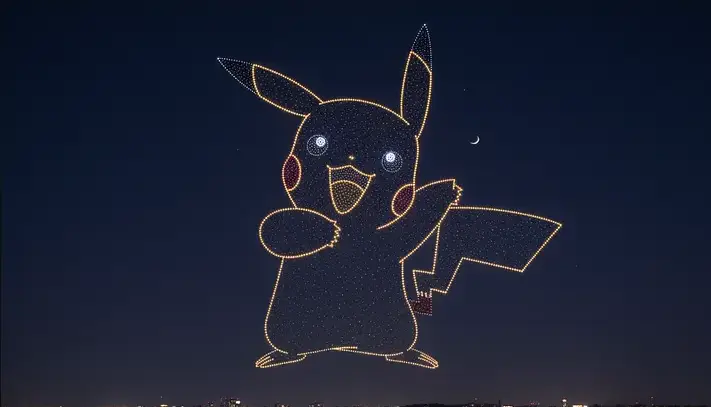
Last night, I was standing on the cold wet sand watching 200 drones swarm the sky like a hive of digital fireflies. As they locked into formation, the dark California sky didn’t just hold stars anymore—it held a giant, glowing, neon Pikachu.
As the drones hovered perfectly synced, mathematically precise, and looking more like a low-res rendering than a physical object—the conversation among the crew naturally spiraled. We started talking about The Matrix. Then someone brought up The Great Flood on Netflix, with its haunting questions about cyclical history and hidden truths. By the time the drones landed, the “Simulation Theory” rabbit hole had opened wide.
What started as a tech demo turned into an overnight obsession: Are we the ones flying the drones, or are we the ones inside the display?
For the engineering community, this isn’t just a stoner thought. It’s a series of computational problems that look suspiciously like the world we’re currently building.
The Math of the Matrix
The shift from sci-fi trope to serious inquiry began in 2003 with Oxford philosopher Nick Bostrom. His paper, “Are You Living in a Computer Simulation?”, didn’t just ask “what if”—it provided a probabilistic trap.
Bostrom’s “Simulation Trilemma” argues that if any civilization reaches a point where they can run high-fidelity “ancestor simulations,” they will likely run millions of them.
He formalized this with an elegant equation. If fp is the fraction of civilizations that survive to reach “technological maturity,” and N is the average number of simulations they run—if N is large (and why wouldn’t it be?)—the probability that we are the “Base Reality” drops to near zero.
Statistically, you aren’t the player; you’re the NPC.
The Universe as a Compressed File
Engineers see “code” where others see “nature.”
Take the recent work of Dr. Melvin Vopson. In his 2023/2024 papers on the Second Law of Infodynamics, Vopson suggests that the universe actively works to minimize information entropy. To a physicist, it’s a law; to a software engineer, it looks like a data compression algorithm.
Vopson’s 2025 paper, “Is Gravity Evidence of a Computational Universe?”, even suggests information has physical mass. If true, matter isn’t “stuff”—it’s the physical output of stored data. It’s as if the universe is trying to save disk space by only rendering the essentials.
MIT’s Rizwan Virk takes this further. He points to the “Planck Length”—the smallest possible measurement in physics—and calls it what it is: a pixel. He views the speed of light not as a physical barrier, but as the processor speed limit of the hardware we’re running on.
The Glitch in the Logic
Not everyone is ready to accept the “Source Code.”
In June 2025, Dr. Mir Faizal and Lawrence Krauss published a counter-strike in the Journal of Holography Applications in Physics. Using Gödel’s Incompleteness Theorem, they argue that certain physical phenomena are “non-algorithmic.” Their claim? If you can’t turn a physical process into a step-by-step script, the universe cannot be a digital simulation.
It’s the ultimate “patch” to the theory—an argument that reality is too messy for a CPU to handle.
The Inception Loop: From Unity to Reality
The most compelling evidence, however, might be sitting on our own hard drives. We aren’t just theorizing about simulations; we are actively building them.
Today, we use engines like Unity and Unreal Engine to create “Synthetic Environments.” We aren’t just making games—we are creating physics-perfect worlds to train AI.
AI Training Grounds: We build digital cities so autonomous cars can crash ten million times without a single scratch in “Base Reality.”
Reinforcement Learning: We drop AI agents into these simulations and let them evolve.
The Nesting Doll: If we are already creating simulations to train our AI, it’s only a matter of time before that AI creates its own sub-simulations to solve its own problems.
Standing on that beach in Newport, watching 200 drones mimic a Pokemon character—the “Simulation Point” felt closer than ever. Once our VR and AI become indistinguishable from reality, the probability that we are the first to reach this milestone becomes vanishingly small.
We used to look at the stars and see gods. Now, we look at the sky, see a drone-lit Pikachu—and see a user interface.
Whether we are the programmers or the program, one thing is clear: the “Great Flood” of data is already here, and we’re all just trying to read the code.
About Alan Scott Encinas

I design and scale intelligent systems across cognitive AI, autonomous technologies, and defense. Writing on what I've built, what I've learned, and what actually works.

About • Cognitive AI • Autonomous Systems • Building with AI
RELATED ARTICLES
→ How Early Digital Systems Quietly Shaped the Minds Building Tomorrow


QMDCmaSgZgwjWeuzRwjgTjcz