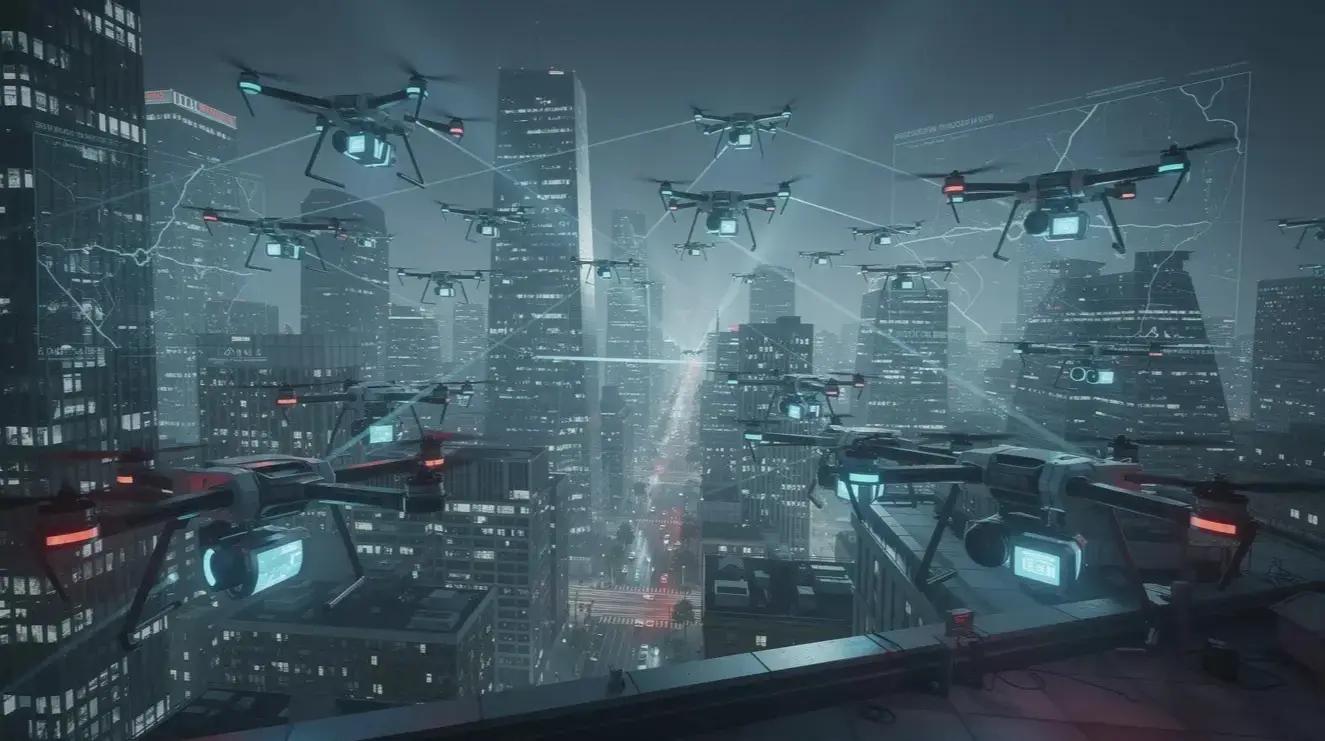
Cinematic sci-fi and new modern conflict are forcing a shift from piloting single drones to orchestrating a collective intelligence.
The Origin of COV
COV, or better known as Cognitive Orchestration & Vision, didn’t emerge from speculative futurism. It emerged from a convergence of existing systems, peer-reviewed research, and a coordination problem that modern autonomy still hasn’t solved.
The earliest spark came years ago from Prometheus—specifically the scene where autonomous mapping drones enter an unknown structure, perform local sensing, and generate a real-time spatial model without continuous human control. At the time, that scene felt aspirational rather than practical.
Today, the gap between fiction and feasibility has narrowed dramatically.
Edge compute, compact sensors, and on-device inference have quietly removed the original hardware constraints. The remaining bottleneck is not perception or mobility. It is coordination under cognitive load.
The Measured Problem: Human-Limited Scaling
Recent multi-agent and human-swarm teaming studies converge on the same conclusion: as the number of autonomous units increases, human-in-the-loop control does not degrade linearly—it collapses.
The failure mode is cognitive.
Experiments in disaster search and rescue, infrastructure inspection, and dynamic surveillance environments show that operator performance plateaus well before hardware limits are reached. Even with partial autonomy, manual task reassignment, video monitoring, and exception handling saturate human working memory.
This phenomenon is increasingly described as a cognitive load wall: a threshold beyond which adding more agents reduces marginal productivity instead of increasing it.
Crossing that wall requires a different interaction model, not faster humans.
Why Vision-Language Models Change the Equation
Most multi-drone systems still rely on streaming raw sensor data to a central operator. This design assumes that higher fidelity equals better understanding. Empirically, that assumption fails at scale.
Vision-Language Models (VLMs) enable a different approach: perception is interpreted locally and transmitted semantically. Instead of sending video, each agent reports structured meaning—fracture detected at joint four, vegetation stress cluster expanding, thermal anomaly moving east.
Human-swarm cognition research shows that semantic abstraction, not visual bandwidth, is what preserves operator effectiveness as system complexity grows. Operators remain situationally aware while cognitive load drops significantly.
In practice, this shift replaces continuous visual monitoring with event-driven understanding. Humans supervise intent and outcomes, not pixels.
From Autonomous Units to Cognitive Systems
Single-agent autonomy is no longer the frontier. AI pilots capable of navigating, avoiding obstacles, and completing isolated tasks are already emerging.
The unresolved challenge is fleet-level cognition.
COV addresses this by introducing a global orchestration layer that decomposes high-level objectives into distributed tasks, reallocates workloads dynamically, and compensates for partial failures without human intervention.
This is not speculative behavior. In orchestrated ensemble trials, missions maintain near-complete coverage even when a significant fraction of agents experience battery depletion or failure mid-operation. Compared to manually coordinated fleets, success rates increase markedly while operator workload decreases.
The system behaves less like a collection of drones and more like a coherent organism.
Why This Extends Beyond Defense
The relevance of cognitive orchestration extends far beyond military use cases.
In wildfire response, orchestrated aerial systems can operate inside smoke-occluded environments where human crews and helicopters cannot safely enter. In archaeology, micro-drone ensembles can map sealed chambers, collapsed structures, and unstable ruins without excavation. In space exploration, where communication latency makes teleoperation impractical, autonomous orchestration becomes a prerequisite rather than an enhancement.
These applications have existed in theory for years. What changed is feasibility.
As Deloitte noted in its 2025 analysis of agentic AI systems, orchestration—not raw autonomy—is emerging as the decisive layer. Intelligence without coordination does not scale.
What This Work Claims, and What It Doesn’t
COV does not claim general intelligence, sentient swarms, or fully autonomous systems operating without oversight.
It makes narrower, testable claims:
- Humans scale poorly at micromanagement.
- Semantic abstraction scales better than sensory fidelity.
- Orchestrated systems outperform manually coordinated ones under uncertainty.
- Vision-language interfaces reduce cognitive load while preserving control.
Anything beyond that is extrapolation and should be treated as such.
Why Fiction Finally Became Practical
What makes scenes like those in Prometheus feel newly plausible is not imagination catching up to reality—it’s reality catching up to systems thinking.
Hardware matured. AI moved to the edge. Cognitive load became measurable. Orchestration emerged as the missing layer.
COV sits at that intersection.
Not as a cinematic concept, but as an applied cognitive system grounded in current research, measurable outcomes, and real operational constraints.
The open question is no longer whether this class of system is possible. It’s who formalizes it first—and who understands that autonomy alone was never the hard part.
About Alan Scott Encinas
I design and scale intelligent systems across cognitive AI, autonomous technologies, and defense. Writing on what I’ve built, what I’ve learned, and what actually works.
About • Cognitive AI • Autonomous Systems • Building with AI