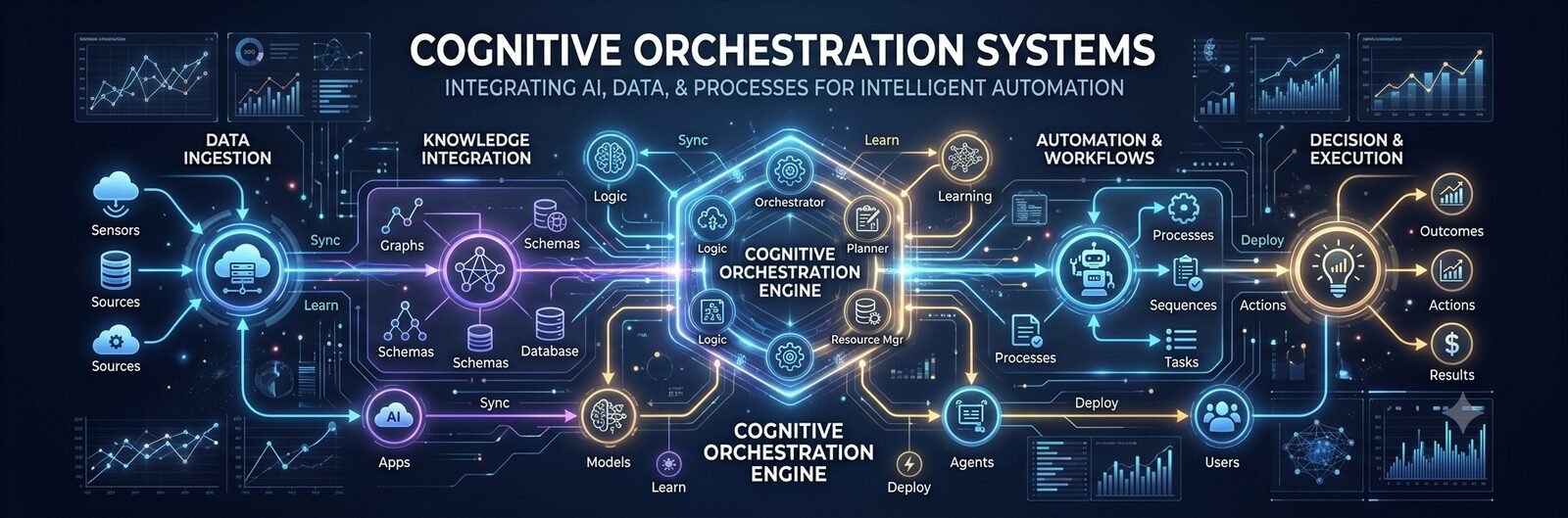
What Is a Cognitive System? Software That Pursues Goals, Not Instructions
From applications to goal-seeking systems.
The first time one of my systems did something I hadn’t told it to do, I went looking for the bug. There wasn’t one. It had hit a dead end I never planned for, backed up, and found another route to the goal.
I had spent my whole career writing software that does exactly what it is told and nothing more. That was the first time I had built something that did what it was for instead of only what it was instructed. That gap, between instruction and intent, is the whole subject here.
For most of computing history, software has been designed around a simple principle: humans define instructions, and machines execute them. Traditional applications are passive utilities. They wait for a user or another system to provide an input, execute a predefined sequence of operations, return an output, and stop. The software may be incredibly complex, but its fundamental behavior is deterministic because the possible paths of execution have been explicitly designed by engineers.
This model has powered modern computing for decades. Databases, operating systems, enterprise applications, and distributed services all rely on the same fundamental assumption: if we define the rules clearly enough, the system will behave predictably.
Foundation models introduced a different computational paradigm. Instead of following explicit instructions and returning predictable outputs, they generate probabilistic responses based on patterns learned from vast amounts of data. They can interpret ambiguity, generate novel solutions, and adapt to situations that were never explicitly programmed. However, this flexibility introduces uncertainty into systems that were historically built around removing uncertainty.
The challenge facing modern AI engineering is not simply creating more capable models. The challenge is designing software architectures that can reliably operate with systems that are powerful but inherently probabilistic.
That requires a new category of software: cognitive systems.
Definition
A cognitive system is software organized around continuous cognition rather than discrete execution. It perceives state, synthesizes understanding, formulates plans, executes actions, evaluates outcomes, and adapts toward objectives under uncertainty.
Unlike traditional applications, cognitive systems are not primarily defined by the functions they perform. They are defined by the objectives they pursue and their ability to determine the appropriate path toward those objectives.
The engineer no longer specifies every possible action the system should take. Instead, the engineer defines the goal, available capabilities, operational constraints, and methods for evaluating success. The system then determines how to navigate from the current state toward the desired outcome.
This represents a fundamental shift from software that executes instructions to software that manages objectives.
From Instructions to Objectives
The difference between traditional applications and cognitive systems begins with the relationship between humans and machines.
Traditional software operates through a functional contract: given Input X, execute Procedure Y, and return Output Z. The engineer designs the workflow, defines the logic, anticipates edge cases, and determines the appropriate response for each scenario. The software itself does not make decisions about the objective; it simply executes the decisions already encoded into it.
A cognitive system operates under a different contract. Instead of receiving a complete set of instructions, it receives an objective, a current understanding of the environment, and a set of constraints.
It is the difference between a player piano and a jazz musician. A player piano executes a punched roll flawlessly, note for note, and it can do nothing else. When the roll runs out, so does the music. A jazz musician is handed a chord chart and a destination and works out the notes in the moment, around whatever the rest of the room is doing. Traditional software is the player piano. A cognitive system is the musician.
The question changes from:
"How do I execute this predefined workflow?"
to:
"What is the best sequence of actions required to achieve this objective given the current information available?"
This distinction is critical. Cognitive systems are not simply applications with more sophisticated inputs and outputs. They are architectures designed around continuous decision-making, where execution itself becomes an adaptive process.
Traditional software tracks execution state. A cognitive system manages a reasoning process.
The Cognitive Loop
Cognitive systems operate through continuous feedback loops rather than fixed execution paths. While implementations will vary, the fundamental pattern remains consistent:
Observe → Understand → Plan → Act → Verify → Learn → Observe
This is not a new shape. It is the loop a fighter pilot runs under pressure, observe, orient, decide, act, and the one a helmsman runs in rough water, correcting the course continuously instead of setting it once and hoping. What is striking is that the industry landed on the same cycle independently. NVIDIA, IBM, and AWS, who share no common style guide, all describe an AI agent as something that perceives, reasons, and acts toward a goal, then learns from the result. When everyone building the thing reaches for the same shape, it is usually the problem forcing their hand, not fashion.
The system begins by observing available information and synthesizing an understanding of the current state. It then evaluates possible actions, executes a chosen strategy, verifies the result, and incorporates the outcome into future decisions.
This loop allows the system to adapt when reality does not match expectations. An external API may return unexpected data. A user request may contain ambiguity. A model response may lack sufficient confidence. Instead of treating these situations as failures, a cognitive system treats them as conditions requiring additional reasoning and adaptation.
The defining characteristic is not that the system always produces the correct answer. It is that the system has mechanisms to recognize uncertainty and respond intelligently.
Anatomy of a Cognitive System
Building cognitive systems requires a different architectural approach than traditional applications.
| Architectural Dimension | Traditional Application | Cognitive System |
|---|---|---|
| Primary Goal | Execute instructions | Achieve objectives |
| Execution Model | Predetermined workflows | Adaptive planning loops |
| Decision Making | Hardcoded logic | Dynamic evaluation |
| State | Database records and session data | Synthesized understanding of the current situation |
| Memory | Stored information | Accumulated experience and learned patterns |
| Error Handling | Exceptions and failures | Verification, recovery, and strategy adjustment |
| Improvement | New software releases | Continuous adaptation through experience |
The difference is not simply the addition of artificial intelligence. The difference is the architecture surrounding intelligence.
Models Are Components, Not Systems
One of the most common misconceptions in modern AI development is that adding a foundation model to an existing application creates a cognitive system.
It does not.
A foundation model is a powerful computational component, but it is not an entire intelligent architecture. A processor can perform calculations, but it does not define an operating system. Similarly, a model can generate reasoning-like outputs, but it does not provide the mechanisms required for reliable cognition.
A true cognitive system requires additional architectural capabilities: maintaining state, planning actions, accessing memory, verifying outputs, interacting with external tools, and adapting strategies based on outcomes.
The model provides the capability for inference. The cognitive architecture provides reliability, continuity, and purposeful behavior. Coordinating that architecture so it stays reliable under uncertainty is a discipline of its own, cognitive orchestration; a working example is a system of twenty-one agents that never talk to each other directly, coordinated entirely through a central architecture.
Beyond Static Software
The most significant difference between traditional applications and cognitive systems is their relationship with change.
Traditional software remains static after compilation. It is a statue: finished the moment it is carved, and changed only when someone picks up the chisel again. Its capabilities improve when engineers modify the underlying code and release a new version.
Cognitive systems introduce a different model. Through persistent memory and accumulated experience, they can improve their future behavior based on previous interactions and outcomes. They can recognize recurring patterns, remember successful approaches, identify failures, and adjust their strategies.
This does not mean cognitive systems independently rewrite themselves or replace engineering. Rather, it means the system’s operational capability can evolve through experience instead of relying exclusively on manual updates.
Software moves from being a fixed tool toward becoming an adaptive system.
The Category Is Arriving
For a long time, building software this way was a fringe idea. It is not anymore.
Gartner named agentic AI its top strategic technology trend for 2025 and described it in almost exactly the terms above: a goal-driven digital workforce that autonomously makes plans and takes actions. Their forecast is that agentic AI will move from less than 1% of enterprise software applications in 2024 to 33% by 2028, and that the share of day-to-day work decisions made autonomously will climb from zero to at least 15% over the same window. A category that barely existed is being projected to become a third of enterprise software in four years.
The definitions are converging, too. NVIDIA, IBM, and AWS, who share no style guide, all describe an agent the same way: something that perceives, reasons, and acts toward a goal, then learns from the result. That is the cognitive loop, reached independently by the people actually shipping these systems.
None of which means it is easy, or that the hype is all earned. Gartner also expects more than 40% of agentic AI projects to be cancelled by the end of 2027, undone by cost, unclear value, and weak controls. That number is not an argument against cognitive systems. It is an argument for taking the architecture seriously. Klarna is the cautionary tale: its goal-directed assistant handled two-thirds of customer service chats in its first month, and then the company quietly rehired human agents in 2025 after quality slipped on the hard cases. The lesson is not that goal-driven software does not work. It is that a goal without the right architecture around it, the verification, the memory, the judgment to escalate, will find the fastest route to a bad outcome as readily as a good one.
A cognitive system is not a model with ambitions. It is the architecture that makes the ambition safe to hand over.
The Next Computing Paradigm
The history of software has largely been defined by deterministic execution. Engineers translated human intent into explicit instructions, and computers executed those instructions at scale.
Cognitive systems represent a new abstraction layer. Engineers define objectives, constraints, capabilities, and evaluation mechanisms. The system determines execution by continuously interpreting information, planning actions, and adapting to changing conditions.
This does not replace traditional software. Deterministic systems remain essential for calculations, transactions, infrastructure, and operations where precision is required.
Instead, cognitive systems introduce a new layer that operates where uncertainty, ambiguity, and complex decision-making exist.
The future of software will not be defined by replacing deterministic systems with probabilistic ones. It will be defined by combining both.
Models generate possibilities. Deterministic systems provide precision. Cognitive architectures connect them into reliable systems capable of pursuing goals in the real world.
Key takeaways
- A cognitive system is software organized around a goal rather than a fixed set of instructions. It perceives, plans, acts, verifies, and adapts under uncertainty.
- The contract changes from "given input X, run procedure Y, return output Z" to "here is the objective and the constraints, work out the best way to reach them."
- A foundation model is a component, not a system. The model supplies inference; the architecture around it (state, planning, verification, memory) supplies reliability, continuity, and purposeful behavior.
- Cognitive systems improve by running, not only by shipping new code, because persistent memory lets them accumulate experience across interactions.
- This is not fringe anymore: Gartner projects agentic AI going from under 1% of enterprise software in 2024 to 33% by 2028, while also expecting 40%+ of those projects to fail. That failure rate is exactly why the architecture, not the model, is the hard part.
- Cognitive systems do not replace deterministic software. They add a layer for the ambiguous, uncertain work and combine with precise deterministic systems.
FAQ
What is a cognitive system? A cognitive system is software organized around continuous cognition rather than discrete execution. Instead of running a fixed sequence of instructions, it perceives the current state, synthesizes an understanding of it, forms a plan, acts, evaluates the outcome, and adapts toward a defined objective under uncertainty. The engineer defines the goal, constraints, capabilities, and evaluation criteria; the system determines the execution.
How is a cognitive system different from a traditional application? A traditional application runs predetermined workflows: given input X it executes procedure Y and returns output Z, with every branch anticipated in code before it runs. A cognitive system is given an objective and constraints and works out the best sequence of actions to reach them, deciding what to do next from its evolving understanding rather than a fixed path. Traditional software tracks execution state; a cognitive system manages a reasoning process, and it improves as it runs rather than only when engineers change the code.
Does adding an LLM to my app make it a cognitive system? Not on its own. A foundation model is one computational component within a larger architecture, like a processor that performs calculations without being an operating system. A system becomes cognitive only when the model is embedded in an architecture that maintains state, plans actions, verifies outputs, accesses memory, invokes external tools, and adapts strategy over time. The model provides inference; the architecture provides reliability.
Do cognitive systems replace traditional software? No. Deterministic systems remain essential wherever precision is required, such as calculations, transactions, and infrastructure. Cognitive systems introduce a new layer for the work that involves uncertainty, ambiguity, and complex decision-making. The future is not probabilistic systems replacing deterministic ones; it is the two combined, with cognitive architectures connecting them into reliable systems.
How does a cognitive system relate to cognitive orchestration? A cognitive system is the software organized around goals. Cognitive orchestration is the architectural discipline of coordinating its probabilistic parts, state, planning, verification, and memory, so it behaves reliably under uncertainty. In short, a cognitive system is the what, and cognitive orchestration is the how.
Related reading
→ What Is Cognitive Orchestration? Why AI Systems Can’t Be Built Like Traditional Software
→ My 21 AI Agents Aren’t Allowed to Talk to Each Other. That’s Why It Works.
→ The Paintbrush Paradox: Why the Monolithic Era of AI Is Crumbling
→ Cognitive AI: The Next Leap from Algorithms to Awareness