Why Your Dashboard Is Lying to You (And What Actually Works)
A shipping route changed on us last year, and I heard about it from a person, not a dashboard.
A logistics contact mentioned, almost in passing, that vessels on a lane we depend on were quietly rerouting. It was weeks before any of it showed up in a freight report. That one conversation was worth more than any forecast we were running, because it let us move before the cost did. We adjusted sourcing while everyone still working off last quarter’s averages was about to get surprised.
That is the whole game now. And most companies are still playing the old one.
Efficiency Was Built for a World That Stopped Existing
For decades, businesses were built around a simple assumption: efficiency creates advantage. Reduce costs, optimize supply chains, minimize inventory, and scale globally through the lowest possible unit economics. The companies that mastered this model became some of the most successful organizations in modern history.
The strategy made sense because the environment supported it. Transportation networks were predictable, capital was inexpensive, supply chains became increasingly interconnected, and companies could confidently plan around historical averages. The goal was straightforward: remove waste, increase scale, and create the most efficient operation possible.
But efficiency depends on stability.
The environment businesses operate in today is fundamentally different. Tariffs shift, geopolitical conflicts disrupt trade routes, fuel markets become volatile, interest rates change capital availability, and consumer behavior moves faster than traditional planning cycles can adapt. This is not a feeling. In 2024, nine in ten supply-chain leaders reported running into disruptions, and by late 2025, 82% of companies said new tariffs were directly affecting their supply chains, with 39% already seeing supplier and material costs rise. Ocean freight rates told the same story from a different angle: they roughly doubled and then fell about 45% inside a single year.
These are no longer isolated events that companies can analyze individually. They are interconnected signals inside one global operating system.
A tariff increase does not simply raise the price of a product. It changes sourcing decisions, production locations, inventory strategy, pricing models, and cash flow requirements.
A conflict near a major shipping corridor does not simply delay a container. It affects fuel consumption, insurance premiums, vessel capacity, transit times, and the amount of capital tied up in inventory moving across the world.
A spike in energy costs does not simply increase transportation expenses. It moves through every layer of production, because fuel is embedded into the movement of raw materials, components, finished goods, and the infrastructure supporting them.
The hidden problem is that many companies are still optimizing systems designed for a world that no longer exists.
They create forecasts based on historical averages. They calculate margins using expected freight costs. They build inventory plans assuming suppliers, transportation networks, and demand patterns will behave consistently.
But the world is no longer operating on historical averages.
The companies that struggle are often not the ones without intelligence. They are the ones receiving intelligence too late. On average, it takes companies about two weeks to plan and execute a response to a disruption, and two weeks is an eternity when the conditions keep moving underneath you.
The Advantage Moved from Optimization to Awareness
That is the fundamental shift happening in business today. Competitive advantage is moving from pure optimization toward awareness.
Optimization is not disappearing. Efficient operations will always matter. The difference is that efficiency without visibility creates fragility. A company can build the lowest-cost system in the world and still lose if it cannot detect when the conditions around that system are changing.
The next generation of companies will operate differently. They will build sensing systems.
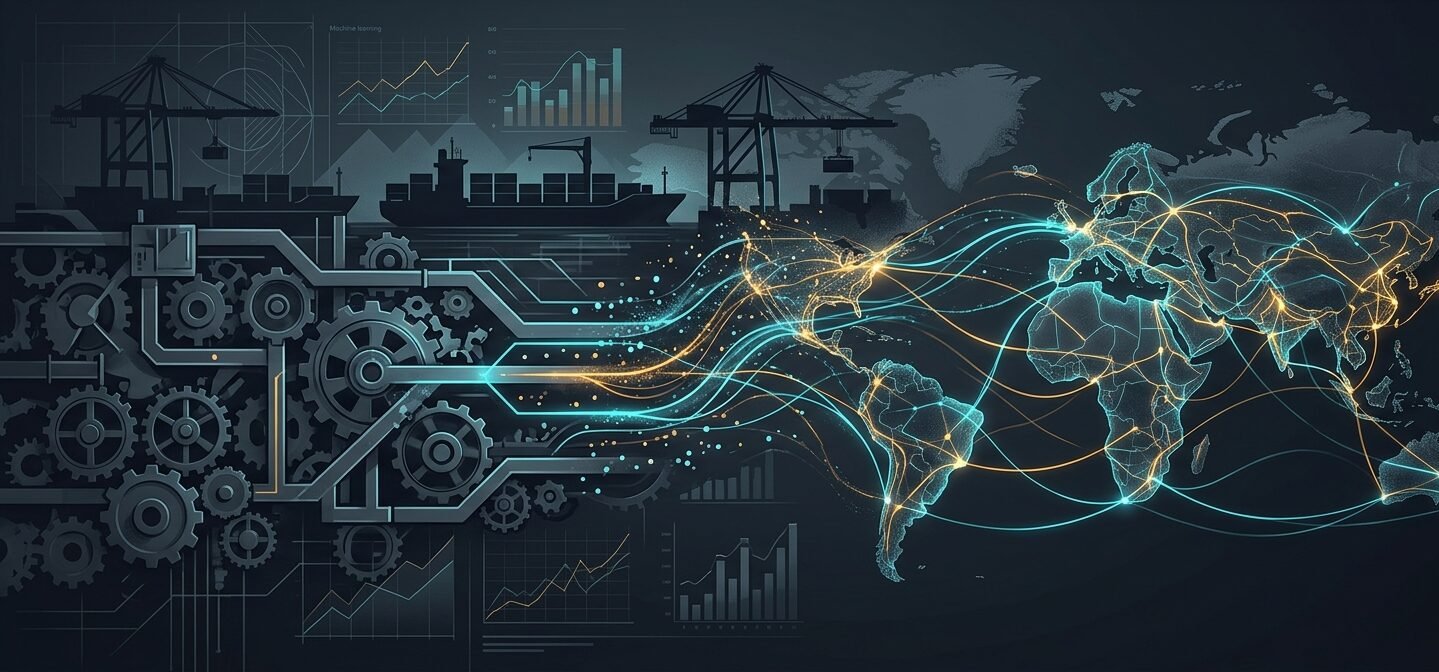
These systems are not just dashboards or reports. They are operational intelligence layers that continuously collect, connect, and interpret signals across the business environment. A company needs to understand how changes in fuel markets interact with freight rates, how port congestion affects production timelines, how currency movements impact sourcing decisions, and how customer search behavior reveals demand shifts before sales numbers reflect them.
The goal is not to predict the future perfectly. That is impossible.
The goal is to identify patterns early enough to create options.
Small Teams, Global Complexity
This shift is already changing how smaller organizations compete globally.
A common assumption is that global operations require massive corporate structures, large departments, and thousands of employees. The reality is that organizational size and operational complexity are no longer directly connected.
In our own operation, we manage a global manufacturing and supply network with a small team. One person focuses heavily on logistics, another focuses on marketing, and I oversee sales, operations, manufacturing relationships, and strategic partnerships.
Yet the complexity of the system we manage is global.
We support manufacturing for a significant portion of the U.S. market within our category. When a shipping route changes, a tariff increases, or a supplier experiences delays, the impact does not stop with our company. It moves through an entire ecosystem of brands, retailers, and customers depending on that production network.
This changes the way you think about business.
The advantage does not come from having the largest team. It comes from having the clearest view of the system.
Why the Barrier Finally Dropped
This is where modern technology creates a fundamental shift.
For years, advanced operational intelligence required expensive enterprise software, large analytics departments, and specialized teams. Today, the barrier has dropped dramatically, and it is not a small drop. The price of AI inference at a fixed level of capability fell from roughly $20 to $0.07 per million tokens between late 2022 and late 2024, more than 280 times cheaper in about two years. By one analyst’s estimate, the cost of equivalent model performance is falling roughly tenfold every year.
A small business and a multinational corporation may have completely different resources, but both now have access to many of the same foundational technologies.
Data pipelines can collect information from multiple sources. Machine learning models can identify patterns across thousands of variables. Forecasting systems can detect anomalies and estimate potential disruptions. Large language models can accelerate research, analyze documents, monitor changing information, and help operators understand complex topics faster than traditional methods.
You can see it starting in the adoption data, even if it looks small. The share of U.S. small businesses embedding AI directly into how they produce goods and services rose from 6.3% to 8.8% in just six months of 2025 (U.S. Census Bureau). Small in absolute terms, but the direction is the story, and the direction is steep.
The technology does not replace judgment.
It shortens the distance between uncertainty and understanding. If you want the deeper version of how that distance gets engineered, it is the same argument I made in The Token Tax: the advantage is not owning the biggest model, it is architecting the layers around it.
Data Alone Is Not the Advantage
But data alone is not enough.
This is where many companies misunderstand artificial intelligence. They assume the advantage comes from having more information. The reality is that information only creates value when it improves decisions.
The strongest systems combine structured data with human intelligence.
A logistics model may identify increasing congestion at a port, but someone still has to call partners, understand what is actually happening on the ground, negotiate alternatives, adjust inventory plans, and communicate with customers.
A market model may identify demand increasing in a region, but someone still has to build relationships, establish trust, and execute locally.
The system identifies the signal. The operator determines the response.
The Layer Everyone Underestimates
This is why traditional data modeling must be combined with something less measurable but equally important: real-world intelligence networks.
The earliest signals often come from the people closest to the system. A logistics provider noticing capacity tightening before official reports are released. A supplier mentioning production challenges before they become public. A conversation with someone working inside a transportation network revealing a potential disruption weeks before it appears in industry data.
This type of intelligence is often dismissed because it is informal. Many cultures simply call it "chisme."
But when structured correctly, it becomes another layer of sensing. It is faster than official data for a simple reason: it travels through relationships, not reporting cycles. A person tells you what they are seeing today, while the report describing it is still weeks from being written.
It is not replacing data science. It is feeding it.
The strongest organizations combine machine intelligence with human networks. The model detects patterns. The relationships provide context. Leadership decides what action to take.
The Board Is Moving While You Play
This is why the game of business has changed.
Business used to feel like chess. The rules were defined, competitors were visible, and the strongest players could plan several moves ahead.
Globalization transformed the board into something closer to 3D chess. Companies had to manage suppliers, currencies, regulations, cultures, and markets simultaneously.
Now the game has become 4D chess.
The fourth dimension is time. The board itself is moving while you are making decisions.
Companies are no longer only competing against competitors. They are competing against information delays, changing conditions, and the speed at which reality changes around them.
The interesting part is that the same forces making business more complex are also creating new opportunities. The tools available today allow companies of almost any size to build systems that would have required entire departments only a few years ago.
The question every company should be asking is no longer simply, "What is happening?"
It is three questions.
What is happening? Why is it happening? How should we respond?
Technology excels at the first two. It organizes information, identifies patterns, and reveals relationships hidden inside complexity. Building that middle layer well is its own discipline, the one I call cognitive orchestration: routing each question to the right mix of deterministic code, models, and human judgment instead of throwing everything at one oracle.
The third question belongs to leadership.
Because systems can reveal opportunities, but humans decide whether to act.
The New Blueprint
The future of business will not belong only to the companies with the most capital, the largest teams, or the longest histories.
It will belong to organizations that can sense change earlier, understand it faster, and execute decisions with greater precision.
The world did not become less competitive because better tools became available.
It became more competitive because everyone now has access to better tools.
The advantage comes from knowing how to build systems around them.
The companies that understand this shift will not eliminate uncertainty. They will become better at operating inside it.
Frequently asked questions
What is operational intelligence?
Operational intelligence is a continuous sensing layer across a business: pipelines and models that collect, connect, and interpret signals (freight rates, port congestion, currency moves, demand shifts) so an operator can spot a change early enough to have options. It is different from a dashboard because its job is not to report what happened, it is to surface what is changing before it lands in the numbers.
Is optimization dead?
No. Efficient operations still matter. The point is that efficiency without visibility creates fragility: the lowest-cost system in the world still loses if it cannot detect when the conditions around it change. Optimization is now table stakes, and awareness is the differentiator.
Do you need a big team or a big budget to build a sensing system?
Not anymore. The cost of the underlying tools has collapsed, with equivalent AI inference falling more than 280 times cheaper between 2022 and 2024 (Stanford HAI). A small team with data pipelines, a few models, and strong relationships can now run a globally complex operation that used to require a department.
What is the "chisme" layer?
It is the informal human intelligence network: the logistics contact, the supplier, the person inside a transport network who tells you what they are seeing before it reaches official data. Structured correctly, it becomes a sensing layer that feeds your models rather than competing with them, and it is often the fastest signal you have.
How do machines and humans divide the work?
The model detects the signal, the relationships supply the context, and leadership decides what to act on. Technology answers "what is happening" and "why," and humans answer "how should we respond." Remove any one of those layers and the other two are worth less.
Related reading