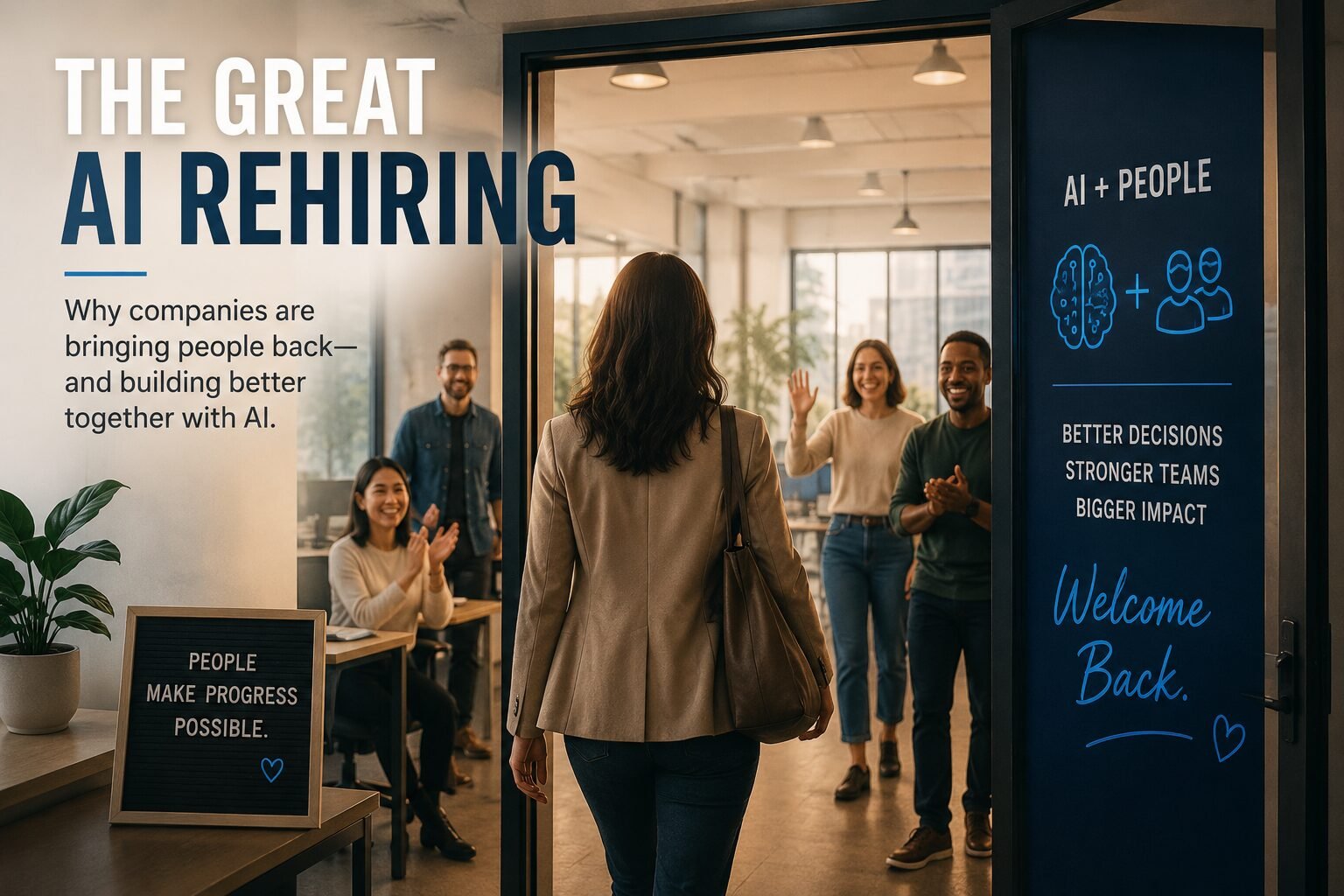
Companies Replaced Their Workers With AI. Now They’re Hiring Them Back to Babysit It.
In early 2024, Klarna stood on a stage and told the world it had built an AI that did the work of 700 customer service agents. It was the headline everyone had been bracing for and dreading at once: the machine had arrived, it was cheaper, and the humans were no longer required. The future had a release date.
A year later, the same company was quietly hiring human support staff again.
That second headline never trended, because the second headline rarely does. The story we were sold is the one where AI replaces us, and that story is loud. The story actually unfolding is quieter, stranger, and a great deal more expensive, and almost nobody is telling it: the companies that fired people for AI are hiring them back, often to babysit the very thing that was supposed to set them free.
AI didn’t take the jobs. Badly built AI is creating them.
Key takeaways
- The dominant fear is that AI will replace workers. The near-term reality is messier: companies that cut staff for AI are rehiring, frequently to supervise the AI itself.
- Gartner projects that by 2027, half of the companies that cut customer-service headcount because of AI will rehire people for similar work, "under different job titles." Klarna already reversed course.
- The failures are structural, not random. Look-alike models and long agent chains fail together and fail late: a step that’s 85% accurate, ten steps deep, succeeds only about 20% of the time.
- The money is moving from production to supervision. Roughly $245K "AI wrangler" roles and governance budgets are where the work is going.
- This is not "AI can’t." It’s "built wrong." Resilient, human-in-the-loop systems are the opposite of fragile.
The reversal nobody put on a slide
Klarna’s CEO, Sebastian Siemiatkowski, did not dress it up. Cost, he told Bloomberg, "unfortunately seems to have been a too predominant evaluation factor when organising this, what you end up having is lower quality." Translation: we optimized for the cheapest possible answer, and we got exactly what we paid for. "Really investing in the quality of the human support," he added, "is the way of the future for us."
Klarna is not an outlier. It is the poster child for a phase the analysts have started, carefully, to name. Gartner now predicts that by 2027, half of the companies that cut customer-service headcount because of AI will rehire people to do similar work, just under different job titles. Read that twice. Not a fringe forecast about a few overreaching startups. Half.
And the executives who made the cuts are already saying it out loud. In a survey of more than 1,100 business leaders, 55% of the ones who had laid people off for AI admitted it was the wrong decision. That is not a technology being adopted. That is a technology being walked back.
The fear was real. The bill is realer.
None of this means the fear was stupid. The fear was rational, and the layoffs were real. What almost no one priced in was how much of the replacement simply would not work.
MIT’s 2025 study of enterprise AI found that 95% of corporate generative-AI pilots delivered little to no measurable impact on the bottom line. Not 95% were mediocre. 95% moved the P&L by essentially nothing. Gartner, looking at the newer wave of "agentic" systems, expects more than 40% of agentic-AI projects to be canceled by the end of 2027, citing escalating costs, unclear value, and inadequate controls.
So companies paid to remove the humans, paid again for the software that was supposed to replace them, watched most of it fail to deliver, and are now paying a third time to bring the humans back. The cheapest-looking decision on the spreadsheet turned out to be one of the most expensive.
The interesting question is not whether this is happening. The receipts are in. The interesting question is why it keeps happening the same way.
Why it breaks all at once
Here is the part the vendors do not put on the slide. These systems do not fail at random. They fail structurally, for two reasons that compound each other.
The first is monoculture. Most of these deployments are built on the same handful of models, trained on overlapping data, carrying the same blind spots. When everything is built from the same genetic material, everything shares the same weaknesses, so when one thing breaks, they all break the same way at the same time. Ireland in 1845 planted one variety of potato across an entire country. One blight, and the whole food supply failed at once, because there was no diversity to fall back on. In 2008 the financial system discovered the same lesson about correlated risk. A monoculture does not fail gracefully. It fails everywhere, together.
The second is the chain. Most "automation" wires these models into a single pipeline, where each step hands off to the next. That sounds efficient until you do the arithmetic. An agent that is 85% accurate at each step sounds reliable. String ten of those steps together and the whole workflow succeeds only about 20% of the time, because the errors multiply. Even a near-perfect 95% per step leaves you at roughly 60% over ten steps.
That is the trap. These systems do not fail in the middle, where someone might catch it. They fail at the end of a long, expensive chain, after the tokens are already spent, after the customer is already annoyed, after the human who would have noticed has already been let go. A monoculture wired into a monolith is brittle by construction. It was never a question of whether it would break. It was a question of how much it would cost when it did.
The money moved from making to minding
So the jobs come back. But they do not come back as the same jobs.
The work is shifting from production to supervision, from doing the thing to governing the machine that does the thing. The budgets tell the story plainly. By one industry survey, 59% of companies are now spending over a million dollars a year on AI, while only 29% report meaningful return, and nearly half of executives called their own AI adoption a "massive disappointment." (That survey was run by an enterprise-AI vendor, so weigh it accordingly, but the direction matches everything else.) The spending did not stop. It moved, toward governance, monitoring, risk, and the people who do it.
Those people have a price. Enterprise machine-learning engineers and AI specialists now command median total compensation around $245,000 at the top firms, with AI-role base salaries running roughly $150,000 to $240,000 across the broader market. Their job is not to be replaced by the AI. Their job is to stand behind it: write the guardrails, catch the failures, keep the thing from quietly rotting. The industry invented a role to do exactly what the laid-off worker used to do for a fraction of the cost, which is notice when something is wrong.
The human in the loop stopped being a nicety and became the cost center. That is where the jobs went.
This is not "AI can’t." It’s "built wrong."
Here is what I want to be careful about, because the easy version of this essay is a victory lap for the people who said AI was overhyped, and that version is also wrong.
The technology is not fake. It is not useless. Most of what got deployed was simply built backwards: a look-alike model bolted onto a single pipeline to cut a line item, with no human standing between the decision and the customer. Build it that way and it will fail the way every monoculture monolith fails, all at once and at the worst time.
Build it the other way and it is the opposite of fragile. I know, because I built that version. Twenty-one small agents that aren’t allowed to talk to each other, each doing one job, sharing a record instead of a conversation, with a human approving every action that reaches a real person. It runs for about $17 and it has never fallen over, because nothing in it depends on everything else. The difference between that and a seven-figure disappointment is not the model. They can run the same model. The difference is the architecture, and the architecture has a person in it on purpose.
What the receipts actually say
We were promised Skynet. We got a hiring plan.
The autonomous future that everyone fears and everyone sells turns out, on inspection, to be neither the Terminator nor the savior. These systems are not coming to replace us, and they are not going to save us either. They are smart, they are genuinely useful, and built correctly they can change the world. But "correctly" has a human in it, and that human is not a rounding error the next model will optimize away. The companies relearning that right now are paying tuition for the lesson, one rehire at a time. The ones who never had to learn it are the ones quietly winning.
The job was never going to be replaced. It was going to be revealed. It turns out the part of the work that was hardest to automate was the part that was always the actual job: judgment, and someone willing to own it.
Frequently asked questions
Are companies really rehiring workers they replaced with AI?
Yes. Gartner projects that by 2027, 50% of companies that cut customer-service headcount because of AI will rehire for similar roles under new titles, and Klarna has already publicly reversed course after admitting its AI-first support pushed quality down. A survey of 1,100+ executives found 55% of those who cut jobs for AI called it the wrong decision.
Why do so many AI and "agentic" projects fail?
Two structural reasons. They tend to be monocultures (the same models and data, so they share the same blind spots and fail together), and they tend to be wired into single pipelines (so per-step errors compound). A workflow of ten steps at 85% accuracy each succeeds only about 20% of the time. MIT found 95% of enterprise generative-AI pilots delivered no measurable bottom-line impact, and Gartner expects over 40% of agentic-AI projects to be canceled by the end of 2027.
So AI isn’t taking jobs at all?
Some roles genuinely were cut, and some won’t come back. But the dominant near-term shift is from production to supervision: the money and the new jobs are moving toward governing, monitoring, and correcting AI systems rather than being replaced by them.
What does a system that’s "built right" look like?
Diverse instead of monoculture, independent instead of monolithic, and human-in-the-loop by design, so it degrades instead of collapsing. I wrote up a working example here: My 21 AI Agents Aren’t Allowed to Talk to Each Other.
Related reading
→ My 21 AI Agents Aren’t Allowed to Talk to Each Other. That’s Why It Works.
→ The Bifurcation of Cognition: How AI Is Splitting the Workforce