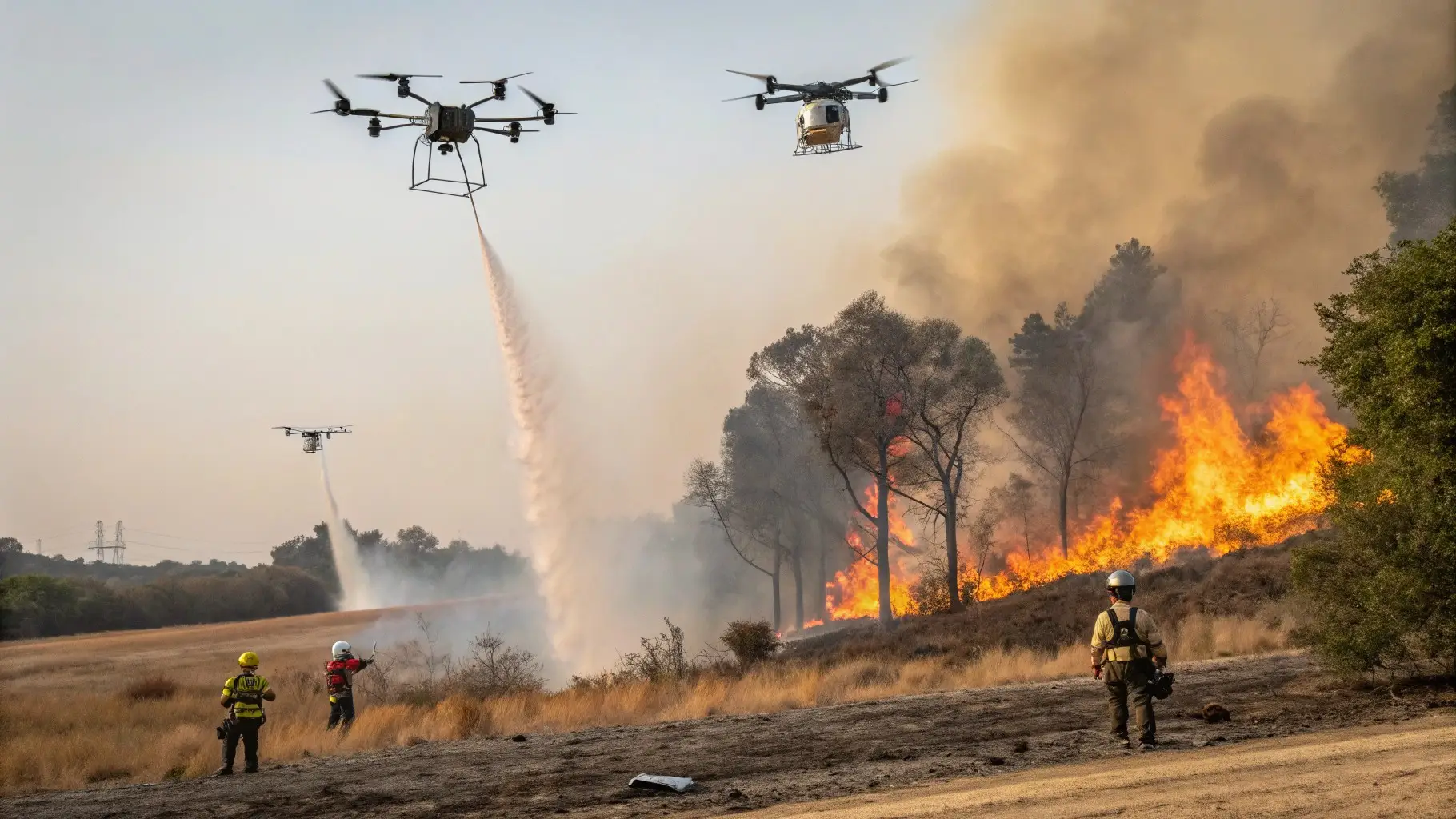
Shifting from Pilot-Centric to Intent-Centric Operations: A Framework for Scaling Autonomous Fleets without Linear Cost.
1. Abstract
The commercial drone industry faces a critical scalability bottleneck: the “1:1 Ratio,” where increasing fleet size linearly increases human cognitive load. This paper introduces Cognitive Orchestration & Vision (COV), a novel architectural framework that decouples mission intent from flight execution. By integrating Large Language Models (LLMs) for high-level task allocation and edge-based Vision-Language Models (VLMs) for semantic perception, COV shifts the human role from “pilot” to “supervisor”. Recent benchmarks from late 2025 indicate that this architecture reduces operator mental workload by 42.9% while improving mission completion times by 64.2% compared to traditional manual control.
2. The Problem: The Cognitive Load Wall
For the past decade, drone innovation has focused on hardware: battery density, rotor efficiency, and payload capacity. However, as enterprise fleets scale, the limiting factor has shifted from flight to coordination.
Managing multiple drones is not just harder than managing one; it is exponentially more taxing due to the “conjunction of events” simultaneous battery alerts, wind shifts, and high-frequency data streams. This “Complexity Wall” prevents true scalability in sectors like disaster response and precision agriculture.
3. The COV Architecture: A Three-Tier Solution
The COV system replaces the traditional “Joystick-to-Motor” telemetry loop with an “Intent-to-Action” semantic loop.
3.1. Layer 1: The Semantic Perceiver (Edge VLM)
Drones utilize lightweight Vision-Language-Action (VLA) models to process visual data locally.
- Function: Instead of streaming raw video, the drone generates text descriptions.
- Output: The drone transmits a “Semantic Signal”: “Detected structural crack on North Pylon, width 2mm”.
- Benefit: This “Semantic Compression” reduces bandwidth usage and filters noise before it reaches the human supervisor.
3.2. Layer 2: The Cognitive Orchestrator (Central LLM)
This central engine acts as the “middle manager” for the fleet.
- Dynamic Task Allocation: The Orchestrator interprets natural language commands (e.g., “Search the northwest quadrant for survivors”) and decomposes them into executable plans for each drone.
- Self-Healing Logic: If a unit reports a low battery or failure, the system automatically identifies the loss and dynamically reroutes other agents to cover abandoned tasks without human intervention.
4. Data-Driven Validation (2025 Benchmarks)
Research published in November 2025 validates the real-world usability of the COV approach:
- Reduced Cognitive Workload: Operators using an LLM-driven cognitive reasoning framework (LLM-CRF) saw their NASA-TLX scores drop from 71.2 to 28.3, effectively moving from a “high” to a “low” stress condition.
- Increased Efficiency: Mission completion times dropped by 64.2% as the system handled complex planning fatigue that often leads to gaps in manual search patterns.
- Superior Reliability: COV-driven swarms achieved a 94.0% mission success rate, outperforming manual operations (87.0%) by ensuring more systematic and exhaustive search coverage.
5. Conclusion: The “Agentic” Shift
The “1:1 Pilot Ratio” is the last great hurdle of the robotics age. By adopting Cognitive Orchestration & Vision, we move from “automating tasks” to “orchestrating intent”. COV provides the reliability of a single drone with the power of a swarm, making large-scale autonomous operations both financially viable and operationally safe.
References
- Chen, J., et al. (Nov 2025). “An LLM-based Framework for Human-Swarm Teaming Cognition in Disaster Search and Rescue.” arXiv:2511.04042.
- CognitiveDrone Project. (2025). “Cognitive Drone: VLA Model & Benchmark.” CognitiveDrone.github.io.
- FlockGPT. (May 2024). “Guiding UAV Flocking with Linguistic Orchestration.” arXiv:2405.05872.
- Nokia Autonomous Networks. (Nov 2025). “Towards cognitive and fully autonomous 6G networks”.
This Paper Covers:
- Complete COV architectural specification (3-tier framework)
- Detailed benchmark results from 2025 field studies
- Vision-Language-Action (VLA) model implementation at edge
- Self-healing task allocation algorithms
- The “Agentic Shift” in autonomous systems design
- Full reference list including arXiv papers and industry research
Related Work:
→ When One Drone Fails, the System Shouldn’t – COV resilience mechanisms
→ Building Systems That Don’t Lie to Themselves – Verification-first architecture
→ MD1 Projects – Cognitive AI research lab