New Tariffs Cover 99.4% of U.S. Imports. Your Plan Doesn’t.
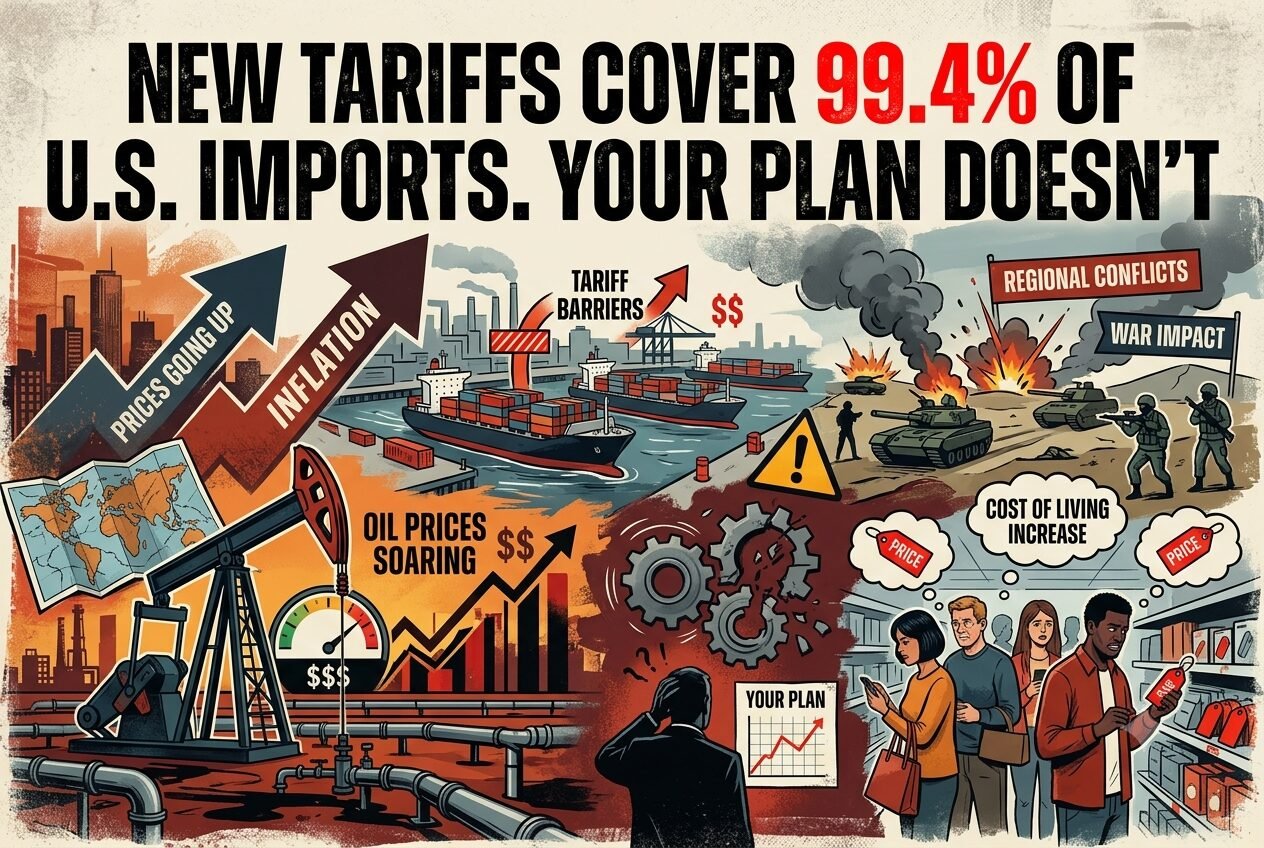
At 12:01 this morning, new tariffs took effect covering 99.4% of everything the United States imports.
Rates of 10% to 12.5% across 60 of the country’s top trading partners, replacing the global tariffs that expired at midnight. That was the third tariff action in four days. On July 20, three proclamations imposed an additional 50% duty on Canadian goods across hundreds of tariff lines, reaching well past the sectors that triggered it into cement, furniture, paper, textiles, cosmetics, and sporting goods. On July 22, a new 25% Section 301 tariff landed on Brazil.
Somewhere in that window, a procurement team placed an order priced against last month’s assumptions.
For decades, many businesses operated on a simple assumption: tomorrow would look enough like yesterday that historical data provided a reliable guide for future decisions. Tariffs evolved slowly through negotiations. Supply chains remained relatively stable. Commodity prices fluctuated within familiar ranges. Quarterly planning worked because the operating environment changed at a pace organizations could absorb.
That assumption is becoming increasingly difficult to defend.
The Signals Are Moving in Different Directions
Individually, these are news stories. Collectively, they reveal something much more important: the assumptions many businesses use for planning are expiring faster than their planning cycles can adapt.
Look at what else moved this week.
War risk insurance premiums on the riskiest voyages have climbed from roughly 0.2% to 0.5% of a vessel’s value to between 3% and 5%. In practical terms a $100 million tanker went from about $250,000 in war risk cover to somewhere between $3 million and $10 million. Increases of 200% to 300% in recent months, and in some cases considerably more, driven by conditions around the Strait of Hormuz and Bab-el-Mandeb.
At the same time, container freight got cheaper. Drewry’s World Container Index fell 4% this week to $4,374 per 40ft box. Shanghai to Los Angeles dropped 3%. Earlier in July the same index was climbing, and it still sits well above where it was a year ago.
Read those two facts side by side. Insurance on the water is spiking. The cost of a box is falling. A company watching only its freight rates would reasonably conclude that conditions are improving.
None of these events alone rewrites the rules of business. Together, they dramatically increase the speed at which operating conditions change.
The Gap Has a Measurable Size
Most companies remain built for delayed feedback. Pricing decisions still rely on last month’s costs. Procurement strategies reflect yesterday’s lead times. Financial plans are built around historical averages that no longer describe current conditions.
That gap is not a metaphor. McKinsey’s Global Supply Chain Leader Survey found that companies take an average of two weeks to plan and execute a response to a supply chain disruption, against a sales and operations execution cycle that typically runs weekly.
The response arrives after the cycle it was meant to inform has already closed.
This is the difference between reporting and sensing.
In Why Your Dashboard Is Lying to You, I wrote about why waiting for a monthly P&L to reveal rising costs means the operational damage has already occurred. Financial reports explain what happened. They rarely provide enough runway to influence what happens next. By the time a change appears on a financial statement, the operational decisions that created it have already been made.
Today’s environment demands something different.
The challenge is no longer collecting data. Most organizations already possess more information than they can realistically process. The challenge is recognizing how independent signals become connected long before they appear in financial performance.
A tariff announcement should not remain isolated within procurement.
A shipping disruption should not remain isolated within logistics.
Commodity prices should not remain isolated within purchasing.
Insurance premiums should not remain isolated within transportation.
Each of these events influences inventory, supplier relationships, customer pricing, production schedules, cash flow, and ultimately profitability. The advantage comes from understanding those relationships while they are still developing rather than after they have already compressed margins.
For companies operating internationally, these changes rarely arrive one at a time. A tariff adjustment influences landed cost. A shipping disruption changes lead times. Insurance premiums alter freight quotes. Commodity markets reshape supplier pricing. None of these decisions happen in isolation, yet many organizations continue to evaluate them independently. The result is that executives often discover the financial impact only after purchase orders have been placed and margins have already been reduced.
This is where modern data science, machine learning, and AI begin serving a fundamentally different purpose.
Not prediction.
Coordination.
The Tactical Sensing Stack
The first layer is continuous data ingestion.
Move beyond periodic reports. Pull live feeds from customs databases, freight indexes such as Drewry or Xeneta, port congestion trackers, commodity markets, weather alerts, and regulatory updates. External events should become continuous operational inputs rather than quarterly discussion points.
The second layer is scenario modeling.
Machine learning does not need to predict the future perfectly to create value. Its role is to continuously evaluate plausible futures. What happens if a shipping route adds twelve days to transit? What happens if tariffs increase another five percent? What happens if supplier lead times double during peak season? Each scenario reveals measurable impacts on inventory, working capital, customer commitments, and margins before those conditions materialize.
The third layer is cognitive orchestration.
Large language models become significantly more valuable when they function as operational connectors rather than chat interfaces.
Here is the version that is not hypothetical. A tariff covering nearly every import takes effect overnight. War risk insurance across a major corridor has risen tenfold over recent months. Container rates have softened slightly. All three happened this week.
A traditional organization may not fully understand the combined financial impact until updated invoices begin arriving weeks later.
A sensing architecture works differently.
It immediately recalculates landed cost, estimates the effect on product margins, identifies affected purchase orders, evaluates alternative suppliers already within the network, updates cash flow projections, and alerts decision-makers before the disruption reaches the balance sheet.
The system is not making executive decisions.
It is dramatically reducing the time between observation and informed action.
That distinction may become one of the defining competitive advantages of the next decade.
The Emerging Competitive Edge
Most organizations still manage through dashboards that summarize yesterday.
The organizations that outperform will increasingly build systems designed to sense today.
There is an important difference between knowing margins declined last month and understanding, in real time, which combination of tariffs, freight disruptions, commodity prices, insurance costs, and demand shifts is likely to pressure margins over the coming weeks.
One explains the past.
The other changes the future.
Static planning assumed the world changed slowly enough that organizations could periodically stop, analyze, and adjust. That assumption is becoming increasingly difficult to maintain. Planning is evolving from a quarterly exercise into a continuous process of sensing, interpreting, and executing as conditions change.
Whether today’s disruption comes from tariffs, conflict, regulatory shifts, or something entirely different is almost beside the point. The specific trigger will change. The underlying pattern will not.
Businesses are entering an environment where meaningful change arrives more frequently, spreads more quickly, and affects more parts of the organization simultaneously. Competitive advantage will increasingly belong to organizations that detect those changes early, understand their implications, and execute before they become visible on a financial statement.
The next competitive advantage will not come from having more data.
It will come from building systems that shorten the distance between change and action.
Frequently Asked Questions
What is supply chain disruption planning?
It is the practice of adjusting sourcing, pricing, inventory and cash flow decisions in response to external shocks such as tariff changes, shipping disruptions, insurance repricing and commodity swings. Traditionally it runs on a quarterly or monthly cycle. The argument here is that the cycle is now slower than the shocks it exists to absorb.
Why is quarterly planning no longer sufficient?
Because the inputs expire faster than the cycle completes. Three separate tariff actions landed in the United States within four days in July 2026, one of them covering 99.4% of imports. McKinsey found companies take roughly two weeks to plan and execute a disruption response against a weekly execution cycle, so the response often lands after the decisions it was meant to inform.
What is the difference between reporting and sensing?
Reporting explains what already happened, usually through financial statements produced after the operational decisions that caused the result. Sensing detects the conditions that will produce a result while there is still time to act on them. A monthly P&L showing compressed margins is reporting. Recalculating landed cost the morning a tariff takes effect is sensing.
How does AI help with supply chain disruption?
Its most useful role is coordination rather than prediction. Models can continuously evaluate plausible scenarios, and language models can connect signals that normally sit in separate departments, recalculating landed cost, flagging affected purchase orders, and surfacing alternative suppliers. The system shortens the distance between an external event and an informed human decision rather than making the decision itself.
What data sources should a sensing system use?
Customs and tariff databases, freight rate indexes such as Drewry or Xeneta, port congestion trackers, marine insurance and war risk pricing, commodity markets, weather and routing alerts, and regulatory feeds. The requirement is that they arrive continuously as operational inputs rather than being reviewed periodically in planning meetings.
Related Reading
- Why Your Dashboard Is Lying to You (And What Actually Works)
- What Is Cognitive Orchestration?
- The Token Tax: Why Bad AI Architecture Is Becoming Enterprise Debt
Sources
- CNBC, Trump to slap sweeping new tariffs on 60 trade partners as global duties expire, July 23, 2026. https://www.cnbc.com/2026/07/23/trump-tariffs-trade-deadline.html
- Office of the Prime Minister of Canada, Statement on the United States administration’s intention to impose new tariffs on Canadian goods, July 20, 2026. https://www.pm.gc.ca/en/news/statements/2026/07/20/statement-prime-minister-carney-united-states-administrations-intention
- The National, Shipping insurance surges again as attacks intensify over Strait of Hormuz, July 17, 2026. https://www.thenationalnews.com/business/2026/07/17/war-risk-shipping-premium-surges-again-as-tensions-escalate-at-strait-of-hormuz/
- Drewry, World Container Index, assessed July 23, 2026. https://www.drewry.co.uk/supply-chain-advisors/supply-chain-expertise/world-container-index-assessed-by-drewry
- McKinsey & Company, Global Supply Chain Leader Survey. https://www.mckinsey.com/capabilities/operations/our-insights/supply-chain-risk-survey-2024