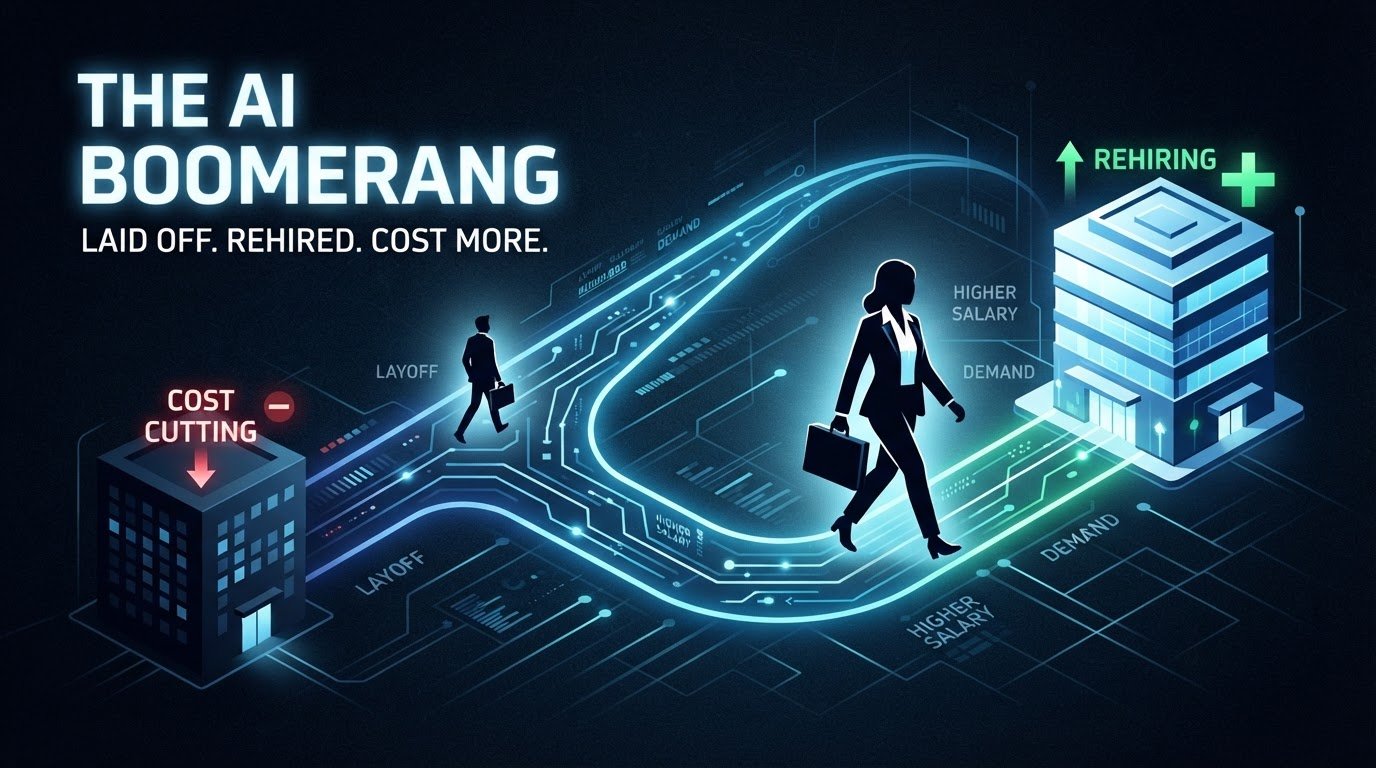
The AI Boomerang: They Laid You Off to Save Money. They’re Paying More to Get You Back.
Ford spent a year letting AI read its engineering requirements, and the cars kept coming off the line with defects nobody caught in time. So in the spring of 2026 it did the unglamorous thing. It called 350 veteran engineers back to their desks. Not fresh graduates. The gray-haired ones who knew, from decades of scar tissue, where a design goes wrong before any software flags it.
Ford’s own VP of vehicle hardware engineering said the quiet part on the record: the company had "mistakenly" assumed that feeding its design requirements into an AI would produce a high-quality product. It did not. Ford rehired the humans, and months later it topped J.D. Power’s 2026 Initial Quality Study. The engineers were never the expensive problem. Firing them was.
This is not a Ford story. It is the story of 2026, and it finally has a name: the AI boomerang.
Key takeaways
- Companies that cut jobs for AI are quietly rehiring. Robert Half found 32% of managers who eliminated a role because of AI later rehired for the same or a similar one.
- The firing was often a bad trade. In a survey of 600 HR leaders, only 26.7% of companies that laid off and then rehired actually came out ahead; nearly a third spent more than they saved.
- The job rarely returns as the same job. It comes back as supervision: someone to catch what the AI gets wrong.
- This is not "AI can’t." It is the market discovering, expensively, that it had priced human judgment at zero.
The reversal nobody put in the budget
Ford is not an outlier. It is the loud example of a quiet correction running through every industry that got sold the same promise.
Robert Half surveyed roughly 2,000 hiring managers and found that 32% of the ones who cut a role because of AI turned around and rehired for the same or a similar position. In finance the number hit 44%. The organizational consultancy Orgvue put a blunter frame on it: 39% of business leaders made staff redundant specifically because of AI, and 55% of them now say it was a mistake.
Read that again. Not "the AI underperformed." A majority of the executives who made the cut are on record calling their own decision wrong. That is not a technology being adopted. That is a technology being walked back, one apology at a time.
The part that should keep a CFO up at night
Here is where the story stops being about capability and starts being about arithmetic.
Careerminds asked 600 HR professionals what the whole cycle actually cost. Only 26.7% of companies that laid off and rehired came out ahead. Nearly a third, 30.9%, spent more on the rehiring than they ever saved on the layoff. The rest roughly broke even. So the modal outcome of firing people for AI, in dollars, was to lose money or tread water.
Think about what that sequence costs. You pay severance to remove the human. You pay for the software meant to replace them. You watch the software miss the 6% that mattered. Then you pay a recruiter, a signing premium, and a ramp-up to bring a human back. Three invoices to end up where you started, minus the institutional knowledge that walked out the door.
The market had priced human judgment at zero. It is the same mispricing at the heart of The Big Short, only pointed at labor instead of mortgages: a whole industry agreed on a number, moved capital as if the number were true, and is now taking the loss as reality corrects it. The judgment was never worthless. It was just invisible on the spreadsheet until it was gone.
The job comes back wearing a different badge
When the humans return, they rarely return to the old job. They return to babysit the machine that was supposed to end it.
IBM is the cleanest picture of the shape. Its AskHR agent handles 94% of routine HR requests without a person, which is a real and impressive number. The trouble lives in the other 6%, the cases that need actual judgment, discretion, an understanding of what a rule is for. IBM is now tripling its U.S. entry-level hiring. The automation did not eliminate the humans. It concentrated them onto the hard part.
That is the re-pricing nobody announced. The returning roles come back rebranded, as "AI operations," "human-in-the-loop," "data quality," and where the judgment is hard to replace they pay a premium, because the work got harder. The human is no longer the cheapest line item doing the routine thing. The human is the expensive one doing the thing the AI can’t.
It does not fall evenly, and honesty demands saying so. Forrester predicts half of AI-attributed layoffs will be quietly reversed, with jobs returning offshore or at lower wages. Judgment that is scarce gets re-priced up. Judgment that can be commoditized gets re-hired cheap. The boomerang is not a guaranteed raise. It is a sorting machine.
Why this was always going to happen
None of this means the AI is fake, and the easy version of this essay, a victory lap for everyone who called AI overhyped, is also wrong.
The technology works. What failed was the assumption underneath the layoff: that a task an AI can do 94% of the time is the same as a job. It never was. I wrote the long version of why these systems break, the structural reason a look-alike model wired into one pipeline fails all at once, and the mechanics have not changed. The failure was predictable. What is new in 2026 is that the receipts finally cleared, and the price tag is public.
So the real question the boomerang leaves on the table is not whether AI takes your job. It is which side of the sorting machine you land on. The workforce is splitting into the people who can audit, correct, and own what the machine produces and the people who only knew how to run the routine it swallowed. One of those is getting a callback at a premium. The other is getting the offshore rate.
What the boomerang actually reveals
We were told the story where the machine arrives and the human is no longer required. The machine arrived. The human turned out to be the part that was mispriced, not the part that was obsolete.
The companies relearning this are paying tuition for it, one rehire and one blown quality study at a time. The ones who never fired their judgment in the first place are quietly eating their lunch. Because the thing that was hardest to automate was never the task. It was the person willing to look at the machine’s confident output and say, that’s wrong, and know why.
That person was never a cost to cut. They were an asset the balance sheet couldn’t see. The market is finding out what they’re worth. Make sure you’re the one it’s looking for.
Frequently asked questions
Are companies really rehiring the workers they replaced with AI?
Yes. Robert Half found 32% of hiring managers who cut a role because of AI later rehired for the same or a similar position (44% in finance). Orgvue found 39% of leaders made staff redundant for AI and 55% now call it a mistake. Ford publicly rehired 350 veteran engineers after AI-based quality tooling missed defects, then topped J.D. Power’s 2026 Initial Quality Study.
Did firing and rehiring actually cost more than it saved?
Often, yes. In a Careerminds survey of 600 HR professionals, only 26.7% of companies that laid off and rehired came out ahead financially, while 30.9% spent more on rehiring than the layoff ever saved. You pay to remove the worker, pay for the software, then pay again to bring a human back, minus the knowledge that left.
Does the boomerang mean AI can’t do the work?
No. AI does tasks, not jobs. An agent that handles 94% of requests still misses the 6% that require judgment, and that residual is exactly where the rehired humans go. The failures are structural, not proof the technology is useless; I break down why these systems collapse in The Great AI Rehiring.
What kind of job comes back after an AI layoff?
Usually supervision, not production, rebranded as "AI operations," "human-in-the-loop," or "data quality." Where the judgment is scarce it pays a premium; where it can be commoditized it returns offshore or at lower wages. The safe position is to be the person who can audit and correct the machine, not the one whose routine it absorbed.
Related reading
→ Companies Replaced Their Workers With AI. Now They’re Hiring Them Back to Babysit It.
→ The Bifurcation of Cognition: How AI Is Splitting the Workforce
→ My 21 AI Agents Aren’t Allowed to Talk to Each Other. That’s Why It Works.