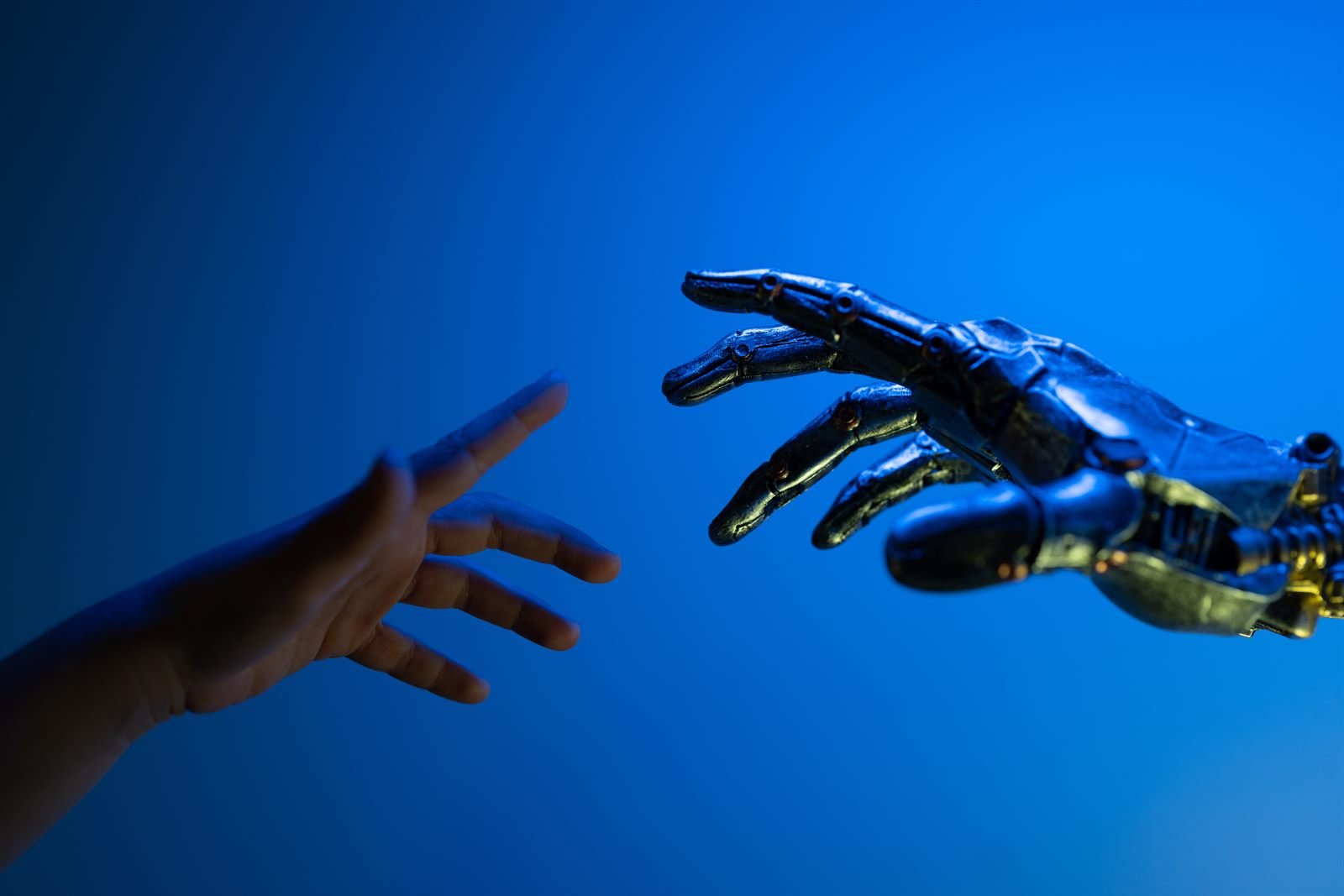
When the medical droid finished rebuilding Luke Skywalker’s severed hand, he flexed the new metal fingers, took a pinprick test without flinching from the strangeness of it, and walked off like nothing had happened. For forty years that scene was the fantasy in one shot: a limb you don’t just wear, you feel.
This year, a lab built the part that always seemed impossible. Not the metal. The wince.
I went looking into where prosthetics and AI actually stand right now, and I came out convinced we are closer to that scene than most people think. Not from one breakthrough, but from four corners of research that quietly started pointing at the same place: robot skin that feels pain, a reasoning test almost no machine can pass, a puzzle game, and the Matrix, more or less, as a training ground.
The skin that flinches
Close your eyes and pick up a paper cup. You won’t crush it, because even without looking, your skin is feeding your nervous system a constant stream of pressure, friction, and heat. Prosthetics have been bad at this for decades; they could grip, but they could not feel.
That gap is closing fast. One 2025 study built an electronic skin with separated sensing layers, so touch and temperature stop bleeding into each other, enough for a robotic hand to tell two similar materials apart by feel alone. That alone is impressive, but the study that stopped me cold was a neuromorphic electronic skin that feels pain.
Not pain for drama. Pain as a survival signal. The researchers wired artificial pain receptors straight into the material. Push it past the point of damage and it fires the same fast electrical pulses your nerves do. Then comes the clever part. A local reflex circuit rips the limb back in hardware, before the signal ever reaches the main computer. It is the exact move your body makes on a hot stove, where your hand is already gone before your brain finishes the word "hot." The skin even maps where it got hurt, so you can pop out a damaged tile and snap in a new one.
The smartest decision this machine makes never reaches its brain. It happens out at the edge, in the skin.
Skynet’s real problem, the one the movies skipped
Here is where the fantasy hits a wall. A reflex saves a limb from one threat. It does nothing for a world that keeps changing.
On screen, an AI like Skynet learns, adapts, and improvises in real time. Real AI mostly does not. Train a model on ten thousand objects and it will grab all of them, but hand it something it has never seen, a wobbly mold of gelatin, and it locks up. There is no rule to look up, so it crushes the thing or drops it. Where a person would adjust without thinking, today’s robot arm just fails.
François Chollet has been hammering this point for years. Intelligence, he argues, is not how well you score on a task you were drowned in data for. It is how efficiently you handle something new. He built a benchmark, ARC, out of small visual puzzles you have never seen, solvable only if you bring human instincts about objects, space, and basic physics. Machines still flounder on it. A recent review found that current solvers leave huge chunks of it unsolved. The newer version turns the test into interactive games you have to explore and plan through, which is a long way from answering a quiz and a short step from steering a body.
Now bring it back to the leg. A prosthetic foot on wet ice cannot wait for a software update. It has to read the shifting map of pressure underneath it and rebalance, right now, from almost nothing. That is fluid intelligence, the one thing the movies always assumed AI would have, and the one thing our real robots still don’t.
We already imagined the fix. It was the Matrix.
So how do you grow a mind that can handle the unknown without testing it on a real person’s leg? You can’t crash-test experimental control software on someone’s actual limb. The stakes are a human being.
The answer the robotics world landed on is science fiction made practical and a little boring. You train the AI inside a simulation. Neo learned kung fu by living it in a dojo that wasn’t real. Modern robots learn to move the same way, by surviving millions of simulated situations before they ever touch the world. The core trick has an unglamorous name, domain randomization. You scramble the simulated world on every run, the lighting, the friction, the physics, so the policy learns to handle chaos instead of memorizing one clean fake room. OpenAI used exactly this to train a robotic hand, entirely in simulation, that then solved a Rubik’s cube in reality. That is the same dexterity a prosthesis is trying to hand back to a person.
And the puzzles, the ARC tasks and the spatial benchmarks, those are not the dojo. They are the final exam. They tell you whether the mind you grew in the simulation is ready for the street.
What this actually adds up to
Stack the pieces and a shape appears. A skin that feels and flinches on its own. A mind trained in a simulation to handle a world it has never seen. A way to measure whether that mind is real before it carries any weight.
None of these is the finished product. Together, they are the scaffolding for something we have only ever watched on a screen. A limb that does not just obey, but participates.
We have imagined this for decades, ever since Luke flexed those metal fingers, and we filed it under far future, the thing that arrives after everything else is solved. It turns out the hard parts were never the metal and the motors. They were the wince and the judgment, and those are the two parts that, this year, quietly started to work.
Stuff you might be wondering
What is neuromorphic electronic skin? Flexible, sensor-packed electronics that encode touch, temperature, and even damaging force the way your nerves do, as electrical pulses. The newest versions can even fire a protective reflex in hardware instead of waiting on a central processor.
Why can’t regular deep learning just run a prosthetic limb? Because deep learning is great at what it trained on and falls apart the moment it meets something new. A real limb constantly meets new objects and terrain, so it needs fluid, few-shot reasoning, not a fixed lookup table.
What does an AI puzzle benchmark have to do with prosthetics? ARC measures whether a system can infer rules from a few examples. That is the same skill a limb needs to read a changing pressure map from its skin and rebalance in real time.
How do you test this safely before it touches a person? You train and stress-test the control software in randomized simulation first, then move it to real hardware only once it holds up. The approach has already worked for dexterous robot hands.
What I read
- Gao, Y., Zhang, J., Zhang, H., … Yu, X. (2025). A neuromorphic robotic electronic skin with active pain and injury perception. PNAS, 122(52), e2520922122. https://doi.org/10.1073/pnas.2520922122
- Ji, J., Luo, H., Su, J., Wang, S., Chen, X., & Song, J. (2025). Multisensory electronic skin with decoupled pressure–temperature-sensing capabilities for similar object recognition. PNAS, 122(41), e2519693122. https://doi.org/10.1073/pnas.2519693122
- Xu, C., Solomon, S. A., & Gao, W. (2023). Artificial intelligence-powered electronic skin. Nature Machine Intelligence, 5(12), 1344–1355. https://doi.org/10.1038/s42256-023-00760-z
- Chollet, F. (2019). On the measure of intelligence. arXiv:1911.01547. https://doi.org/10.48550/arXiv.1911.01547
- Coombe, C., Howard, D., & Browne, W. (2026). State of the ARC: An investigation of learning mechanisms for the Abstraction and Reasoning Corpus. TechRxiv. https://doi.org/10.36227/techrxiv.177162443.32578599/v1
- ARC Prize Foundation. (2026). ARC-AGI-3: A new challenge for frontier agentic intelligence. arXiv:2603.24621. https://doi.org/10.48550/arXiv.2603.24621
- Kaesberg, L. B., Wahle, J. P., Ruas, T., & Gipp, B. (2025). SPaRC: A spatial pathfinding reasoning challenge. EMNLP 2025 (pp. 10359–10390). ACL. https://doi.org/10.18653/v1/2025.emnlp-main.526
- Tobin, J., Fong, R., Ray, A., Schneider, J., Zaremba, W., & Abbeel, P. (2017). Domain randomization for transferring deep neural networks from simulation to the real world. IEEE/RSJ IROS 2017 (pp. 23–30). https://doi.org/10.1109/IROS.2017.8202133
- OpenAI, Akkaya, I., Andrychowicz, M., … Zhang, L. (2019). Solving Rubik’s cube with a robot hand. arXiv:1910.07113. https://doi.org/10.48550/arXiv.1910.07113